

Would you risk your hard-earned savings on a machine that turns into a silent, neon-lit paperweight the moment it arrives in your home arcade? The thrill of the silver ball is addictive, but the dread of hidden "board rot" or a burnt-out transformer can quickly kill the vibe. We know that choosing the right cabinet feels like a high-stakes game of its own! That's why mastering what to look for when buying a pinball machine is the only way to protect your leisure time and your wallet.
Our expert guide gives you the ultimate edge, teaching you how to inspect playfields, electronics, and mechanical reliability like a seasoned pro. You will discover the "holy trinity" of machine health, learn why "home-use-only" (HUO) is the gold standard for South African collectors, and get a clear checklist to spot hidden damage before you commit. Whether you are hunting for a modern masterpiece or a nostalgic classic, we will ensure you choose a machine that holds its value and keeps the high scores coming. Get ready to own the arcade!
Key Takeaways
- Discover why pinball machines are high-value investments and "playable art" that'll transform your social space.
- Master exactly what to look for when buying a pinball machine by prioritising playfield integrity and checking for wear around flippers and inserts.
- Choose between the nostalgic charm of electro-mechanical relays and the digital complexity of solid-state boards based on your maintenance preferences.
- Follow a professional five-point mechanical checklist, including the essential rule of playing three full games before you finalise any deal.
- Learn why sourcing your machine through a trusted South African expert like Arcade Fundi is the smartest way to avoid the hidden risks of private classified ads.
The Thrill of the Silver Ball: Why Pinball Ownership is the Ultimate Upgrade
Nothing beats the thwack of a solenoid firing a steel ball at 30 kilometres per hour. It's physical. It's loud. It's glorious. Unlike digital games that vanish when the power cuts, pinball is a tactile masterpiece that lives and breathes in your room. When you start researching what to look for when buying a pinball machine, you'll quickly realise these aren't just toys. They are mechanical marvels. The History of Pinball shows a transition from simple wooden gravity games to the complex, light-show spectacles we see today, earning them the title of "playable art."
Owning a machine is about more than just high scores. It's about the clatter of the flippers and the physical vibration of the cabinet. However, the South African market is unique. Finding a quality pinball machine for sale South Africa requires a sharp eye. You aren't just buying a game; you're acquiring a piece of high-precision engineering. This is why a professional inspection is non-negotiable for any serious buyer.
Investment Potential vs. Personal Play
Can a pinball machine actually make you money? Often, yes. Certain titles from the 1990s or modern limited runs have seen their values skyrocket amongst collectors. But don't let the Rand signs blind you. Your primary goal should be the "fun factor." A machine that sits unplayed because it is "too valuable" is just expensive furniture. Collectors usually categorise machines into two specific camps:
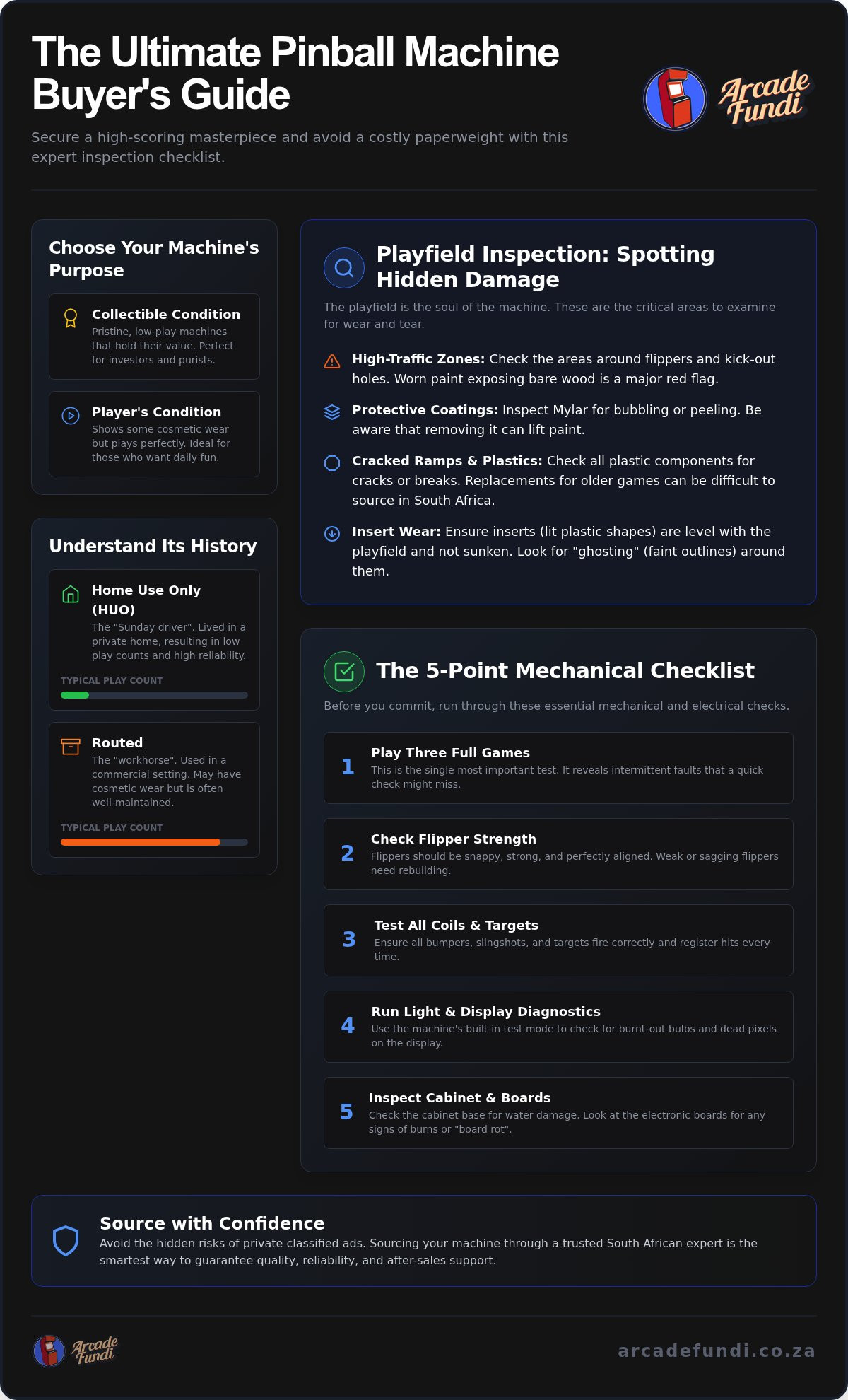
- Collectible Condition: Pristine, low-play machines that look like they just left the factory. These command the highest prices and hold value best.
- Player’s Condition: Machines with some battle scars on the cabinet or minor playfield wear. They play perfectly but are priced for enthusiasts who want to hit the start button every day.
Home Use Only (HUO) vs. Routed Machines
If you want the best of the best, look for "Home Use Only" (HUO). These machines have spent their entire lives in private lounges or games rooms. They haven't endured the sticky floors of a pub or the relentless pounding of a commercial arcade. Because they have fewer "flips" on the odometer, they typically stay reliable for much longer. They are the "Sunday drivers" of the gaming world.
Conversely, "routed" machines are the workhorses of the industry. They have been on a "route" in public venues. Whilst they might have more cosmetic wear, a well-maintained routed machine is often bulletproof. Operators usually replace parts the moment they fail to keep the coins flowing. When deciding what to look for when buying a pinball machine, don't automatically dismiss a routed unit. If the price is right and the maintenance history is solid, it can be a fantastic entry point into the hobby.
Inspecting the Playfield: How to Spot Hidden Damage and Wear
The playfield is the soul of your machine. If the art is worn down to the bare wood, no amount of polish will bring it back! When you are learning what to look for when buying a pinball machine, your eyes must stay glued to the high-traffic zones. Check the area between the flippers and the "kick-out" holes where the ball is ejected. These spots take a relentless beating over the years. If you see wood grain peeking through the paint, you are looking at a costly restoration project.
Modern machines often feature "Diamond Plate" or high-end clear coats that act like a suit of armour. Older titles might have "Mylar" (a clear adhesive plastic) protecting the centre. Check if the Mylar is bubbling or peeling at the edges. Be careful; removing old Mylar can lift the paint right off the wood! If you're worried about long-term care, understanding the basics of pinball machine maintenance will help you spot these red flags early.
Watch out for cracked ramps and shattered plastics. In South Africa, finding a specific replacement ramp for a 30-year-old game can be a logistical headache. It's often better to buy a machine that's physically sound even if it needs a few light bulbs. If you want a machine that has already passed a rigorous physical exam, you can browse pre-inspected pinball machines from experts who know these cabinets inside out.
Insert Ghosting and Wear
Inserts are the translucent plastic shapes that light up to show you your goals. Over decades, the heat from old incandescent bulbs can cause these to expand, contract, and eventually "sink" or "pop" above the wood surface. Ghosting is the separation of the playfield art from the insert. Bring a high-powered torch! Shine it across the playfield at a low angle. If the light catches a "lip" on an insert, the ball will jump and behave unpredictably, ruining your flow.
Cabinet and Backglass Condition
Don't forget the "furniture" aspect. Cabinet art is prone to fading if the machine spent years near a sunny window. Look for vibrant reds and blues; if they look washed out, the value drops significantly. On older machines, check the backglass (the art behind the score display). Is the paint flaking or bubbling? This is called "crazing," and it's a sign of poor climate control. A solid, sturdy cabinet is essential for the heavy-duty play you're going to put it through!
Solid State vs. Electro-Mechanical: Choosing the Right Era
Deciding which era of technology to bring into your home is a massive fork in the road. Are you a tinkerer who loves the smell of ozone and the rhythmic "clack-clack" of physical reels? Or do you crave deep rulesets, cinematic displays, and booming digital soundtracks? Knowing what to look for when buying a pinball machine starts with choosing your tech. Electro-Mechanical (EM) machines are the grandfathers of the arcade, relying on a labyrinth of relays, score motors, and copper switches. Solid State (SS) machines, which took over in the late 1970s, introduced the brains of the operation: microprocessors and circuit boards.
Your choice dictates your weekend plans. EM machines require mechanical empathy and a steady hand with a contact file. SS machines require a basic understanding of electronics and the ability to spot a burnt-out capacitor. If you want a machine that feels like a living, breathing mechanical beast, the 1970s era is calling. If you want a game that plays like a modern blockbuster movie with complex missions, you'll want to look at the digital era. It's a battle between the charm of the past and the power of the future.
The Charm of Electro-Mechanical (EM) Machines
EM machines are a mechanical hobbyist's dream because there are no computer chips to fry. If a flipper stops firing, you can usually trace the physical wire and see the broken connection. The sensory feedback is purely analog. You get real bells and physical score reels that "thud" into place as you rack up points. However, they require patience. Over decades, the factory grease on score reels can become "gummed up," causing the numbers to stick or the machine to fail its reset cycle. They are fantastic for those who find peace in fine-tuning a machine's physical behaviour.
The Power of Solid State (SS) and Modern Games
Solid State machines changed the game with complex rules and interactive displays. You'll find Dot Matrix Displays (DMDs) or, in the case of 2026 models, high-definition LCD screens that guide you through cinematic missions. But there is a silent killer to watch out for. Battery corrosion on the CPU board is the number one killer of SS machines. Old AA batteries used for memory can leak acid, eating through the delicate circuitry. Always ask to see the "backbox" before you pay. Modern 2026 machines from manufacturers like Stern or Jersey Jack now feature LED lighting, high-fidelity sound, and internet connectivity for global leaderboards and software updates.
The 5-Point Mechanical Inspection Checklist for Buyers
You are standing in front of the machine. The lights are flashing. The seller is waiting. Don't let the neon glow distract you! Knowing what to look for when buying a pinball machine means looking past the "wow" factor and into the mechanical guts. You need to be a detective. Is that a genuine part or a bodged repair? Is that sound a game feature or a failing solenoid?
Never buy a machine after just one game. Play at least three full games back-to-back before you even think about reaching for your wallet. Coils and transistors generate heat as they work. A flipper that feels lightning-fast on the first ball might become sluggish and weak by the end of the third game. This is called "flipper fade," and it's a classic sign of aging components or poor power delivery. Listen to the machine. Do you hear a smooth "thwack" or a grinding "crunch"? A healthy machine should sound crisp and purposeful.
On any machine built after the late 1970s, you have a secret weapon: the internal test menu. Open the coin door and find the service buttons. Run the "Solenoid Test" and the "Switch Test." The machine will fire every coil and check every sensor for you. If the screen reports a "Switch Error," you've just found a broken wire or a dead microswitch. It's the most honest conversation you'll ever have with a piece of arcade hardware.
Testing Flipper Strength and Responsiveness
Flippers are the only way you interact with the game. If they are "sticky" or slow to return to their resting position, the mechanical linkages are likely worn or filthy. This usually requires a full rebuild kit. Flipper health is the single best indicator of how well a machine has been maintained. If an owner hasn't spent the small amount of money needed to keep the flippers snappy, they probably haven't looked after the expensive electronics either. When considering what to look for when buying a pinball machine, the flipper response is your primary diagnostic tool.
Electronics and Board Health
Lift the playfield and look at the wiring. It should be tidy and organised. If you see "hacks" like loose wires twisted together or excessive electrical tape, be very cautious. These are ticking time bombs for your electrical system. In the backbox, check the CPU board for battery damage. If you see white, furry corrosion or green stains on the circuit board, that's battery acid. It's a terminal illness for electronics. Burnt connectors in the backbox are easy to spot because the plastic plugs will look scorched, brownish, or melted on the ends. Want to avoid the headache of a hidden lemon? Choose a professionally inspected pinball machine from a team that knows exactly where the gremlins hide.
Finding Your Perfect Match with Arcade Fundi South Africa
Searching for the right cabinet shouldn't feel like a gamble. Whilst private classified ads might look tempting, they often hide the very gremlins we've discussed, from acid-damaged boards to worn-out coils. Knowing what to look for when buying a pinball machine is only half the battle; knowing who to trust is the rest. Arcade Fundi stands as the premier destination for arcade machines for sale South Africa, offering a level of security that a backyard seller simply cannot match.
We don't just move boxes. We facilitate joy. Every machine in our inventory has been through a rigorous inspection process to ensure it meets our high standards for playability and reliability. Whether you're a first-time buyer or a seasoned collector, we provide the expertise needed to turn your games room into a high-octane entertainment hub. We take the guesswork out of the acquisition, leaving you with nothing but the thrill of the game.
The Arcade Fundi Advantage
Why worry about the logistics of moving a 120kg machine? We offer national delivery and professional setup across South Africa, ensuring your new investment arrives safely and perfectly level. Our team handles the heavy lifting and the technical calibration, so you can focus on hitting that first high score. For corporate clients, this means a "plug and play" solution that guarantees high-impact entertainment without the technical stress. Our curated machines are chosen for their durability and "fun factor," giving you peace of mind that your equipment will perform when the competition heats up.
Rental vs. Purchase: Which Suits Your Event?
Not ready to commit to a permanent addition to your lounge? Choosing pinball machine hire South Africa is the perfect way to "test drive" the experience. Rentals are a fantastic choice for corporate functions, themed parties, or short-term activations where you want maximum social engagement without long-term maintenance worries. It's an evocative way to elevate an atmosphere and spark conversation amongst guests. Many of our clients start with a rental for a specific event and find the thrill so addictive they eventually transition to full ownership.
Beyond the silver ball, we offer a complete universe of recreation. From professional-grade pool tables and fast-paced foosball to air hockey and classic jukeboxes, we're your partners in creating the ultimate social space. Don't leave your entertainment to chance. Step up to the flippers with confidence and let us help you build a legacy of play.
Ready to Own the Arcade?
Bringing a pinball machine into your home is about more than just owning a game; it's about preserving a piece of mechanical art that sparks joy for generations. By mastering what to look for when buying a pinball machine, you have moved from a casual fan to a savvy collector. You now know that a pristine playfield and a clean CPU board are the foundations of a solid investment. Whether you choose the rhythmic chimes of the 1970s or the cinematic depth of a modern solid-state model, your decision is now backed by expert knowledge.
Why settle for a risky private deal when you can partner with South Africa's national entertainment specialists? From professional setup to expert technical guidance, we ensure your journey into pinball ownership is smooth and exhilarating. Our range covers everything from retro classics to the latest 2026 releases, alongside pool tables and foosball for the ultimate games room. Ready to level up? Explore our range of pinball machines for sale and hire at Arcade Fundi! Step up to the flippers and start your high-score legacy today!
Frequently Asked Questions
Is it difficult to maintain a pinball machine at home?
Maintaining a pinball machine is easier than you might think! Regular cleaning with high-quality wax and replacing rubber rings every year keeps the game snappy. Whilst modern machines are reliable, you should be comfortable with a screwdriver and a soldering iron for minor tweaks. If you prefer a hands-off approach, buying from a specialist ensures your machine starts in peak condition. It's a rewarding hobby that grows your technical skills over time.
What is the average lifespan of a modern pinball machine?
A well-maintained pinball machine can easily last 30 years or more. Modern machines built in 2026 use durable LED lighting and solid-state electronics designed for heavy commercial use. In a home environment, they face far less stress than they would in a busy pub or arcade. Keeping the playfield clean and the batteries changed on older models is the secret to longevity. These machines are built to be played for a lifetime!
How much space do I need for a standard pinball machine?
You should allow for a footprint of approximately 75cm in width and 140cm in depth. Don't forget to leave at least 90cm of space behind the machine for the player to stand comfortably! Pinball machines are tall, usually reaching about 190cm, so check your ceiling height if you're in a basement. Planning your layout ensures you have enough room for high-energy flipper action without bumping into your pool table or air hockey unit.
Can I still get spare parts for vintage pinball machines in South Africa?
Yes, sourcing spare parts in South Africa is certainly possible through specialist suppliers and dedicated collectors' networks. Whilst some rare mechanical parts for 1970s machines might require international shipping, most common items like rubbers, bulbs, and coils are readily available. When researching what to look for when buying a pinball machine, check if the title is a popular one. Popular games have much better parts support than obscure releases.
What is 'tilt' and does it damage the machine?
A "tilt" occurs when the machine's internal plumb bob sensor detects too much physical movement. It's a classic anti-cheat mechanism designed to stop players from lifting or sliding the cabinet to influence the ball. Don't worry, tilting doesn't damage the electronics or mechanics! It simply ends your current ball and kills the flippers. It's a rite of passage for every player learning to nudge the machine with just enough finesse.
Should I buy a new-in-box (NIB) machine or a used one?
Buying "New-in-Box" gives you the ultimate peace of mind and the latest 2026 technology. You get that fresh-from-the-factory smell and a machine with zero wear. However, used machines often provide better value and allow you to own iconic titles from the 1990s. When deciding what to look for when buying a pinball machine, consider your budget and technical confidence. A pre-inspected used machine from a dealer is often the perfect middle ground.
How do I transport a pinball machine safely?
Safety first! Always remove the heavy steel pinball before moving the machine to avoid smashing the playfield glass. You'll need to fold the backbox down onto the rails and secure it with padding. Use a heavy-duty appliance trolley and at least two people to handle the weight, which often exceeds 110kg. If you're moving it across South Africa, professional transport is highly recommended to ensure the delicate electronics stay seated during transit.
Are pinball machines energy-efficient?
Modern machines are remarkably energy-efficient because they utilise LED lighting instead of hot incandescent bulbs. A machine built today uses roughly the same amount of power as a standard desktop computer whilst in play. Older electro-mechanical machines draw more current to fire their heavy solenoids and relays, but they still won't significantly impact your monthly electricity bill. You can enjoy hours of high-score hunting without worrying about the power meter spinning out of control!