

Picture this: you're one shot away from glory, the room is silent, and you've just executed a flawless bank shot. Suddenly, your opponent pipes up about a "house rule" you've never heard of. Infuriating, isn't it? We've all been caught in the crossfire of conflicting traditions and confusing 8 ball pool rules that turn a friendly match into a boardroom debate. Whether you're playing on a professional-grade table in a sleek office or a favourite local pub, consistency is the centre of any great match.
It's time to reclaim the game and play with the authority of a seasoned pro. This definitive guide will arm you with the knowledge to settle every dispute and lead any match with absolute confidence. We'll dive into the precision of racking the balls, the high-stakes consequences of a foul, and the exact moves required to win fairly. From mastering the break to understanding "ball in hand" privileges, you'll gain the tactical edge needed to dominate the felt. Let's get those balls rolling and transform your next social gathering into a masterclass of skill.
Key Takeaways
- End the "house rules" debate once and for all by mastering the standard 8 ball pool rules! Learn the core mechanics of call-shot play and how to claim your group with confidence.
- Discover how a perfect rack and a strategic "Lag for Break" set the stage for a high-quality match. Starting the frame correctly is the first step toward total table dominance!
- Demystify fouls and penalties to ensure every shot is legal and every consequence is fair. Use "ball in hand" to turn a defensive position into a match-winning opportunity.
- Learn the golden rules for pocketing the 8-ball and securing a clean victory! Clear your group and call your final pocket to prove your status as a true pool master.
The Basics: Understanding the 8 Ball Pool Objective
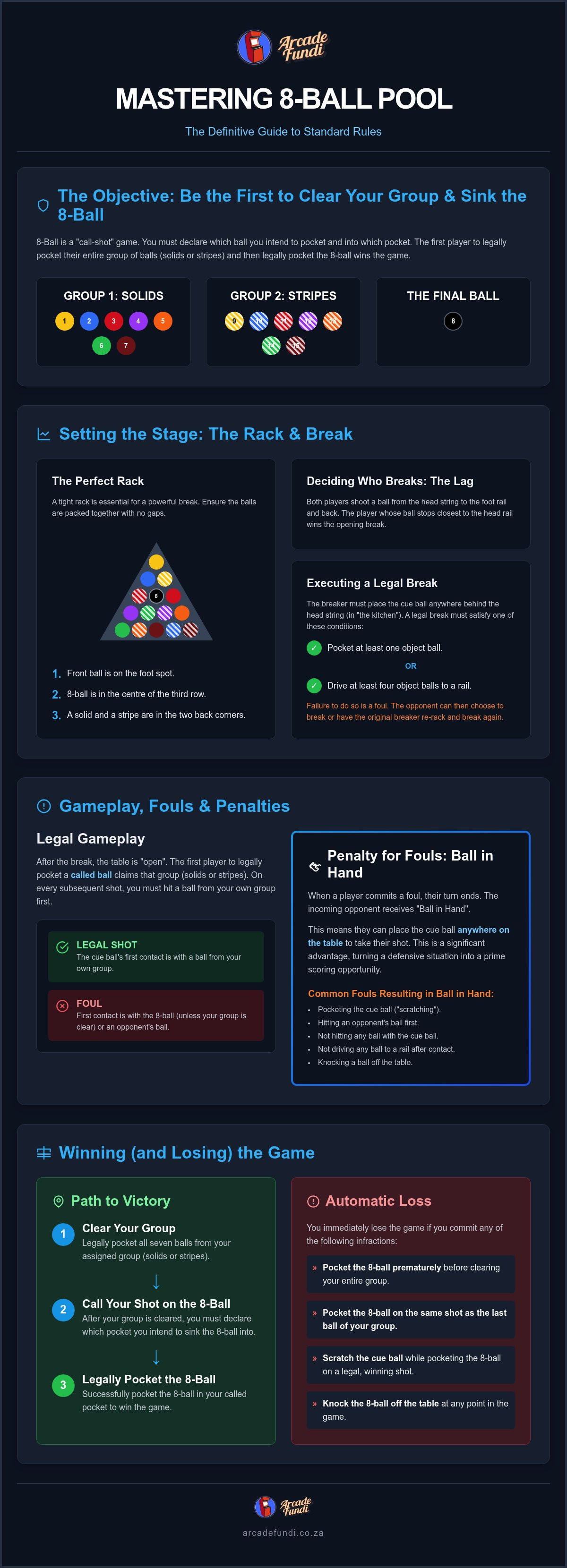
Understanding the 8 ball pool rules is the first step toward dominating the felt. Pool isn't just a casual pastime; it's a high-stakes battle of wits, precision, and social bragging rights. At its core, the game is a "call-shot" challenge. This means you aren't just smashing balls and hoping for a lucky bounce. You're declaring your intent with every stroke. A standard game uses fifteen object balls and a single, pristine white cue ball. The set is split into seven vibrant solid colours (numbered 1 through 7), seven bold stripes (numbered 9 through 15), and the legendary black 8-ball. One player commits to the solids whilst the opponent hunts the stripes. Your mission is clear: legally pocket your entire group, then sink the 8-ball to claim the win.
Choosing Your Group: Solids vs Stripes
The early moments of a match are electric, but they're often where arguments start. Immediately after the break, the table is considered "open." This is a vital nuance in 8 ball pool rules that many casual players overlook. Even if you pocket a solid on the break, the table remains open for the next player. Your group is only officially assigned once you legally pocket a specific, called ball during a subsequent turn. Once your group is locked in, the rules of engagement change. You must strike a ball from your own group first on every single shot. Fail to do so, and you'll likely hand over control of the table to your opponent.
The Equipment You Need for a Fair Game
You can't achieve mastery if your gear is holding you back. Professional gameplay requires tools that respond to your skill with total accuracy. A level, professional-grade table surface is the centre of any fair game. It ensures predictable ball behaviour and rewards true technique. This is why a high-quality table is the ultimate social centrepiece for any office or entertainment room. To play like a pro, you need the right kit:
- The Ball Set: Fifteen perfectly balanced object balls and a responsive cue ball are non-negotiable for a consistent game.
- A High-Quality Cue: Choose a cue that feels balanced in your hand. It's your primary tool for precision and power.
- Chalk: Apply chalk to your cue tip before every shot. It provides the essential friction needed to prevent miscues during high-stakes moments.
Having the right equipment doesn't just make the game more enjoyable; it ensures every win is earned fairly. When you play on a professional-grade table, you remove the excuses and let the talent do the talking. Ready to test your skills?
Racking and the Opening Break: Setting the Stage
Every legendary match starts with a thunderous break. But how do you decide who gets that first explosive shot? Professional 8 ball pool rules dictate a "Lag for Break." Both players shoot a ball simultaneously from the head string to the foot rail and back. The player whose ball stops closest to the head rail wins the right to break. It's a test of touch before the power begins. A clean, powerful break sets the tone for the entire frame, turning a static triangle of balls into a dynamic puzzle of strategy and skill.
How to Organise the Perfect Rack
A sloppy rack leads to a "dead" break, sucking the energy out of the room. To set the stage for a professional-grade split, you need to be meticulous. Place the triangle so the lead ball sits directly on the foot spot. Position the black 8-ball in the exact centre of the third row. To maintain balance, ensure a solid ball is in one rear corner and a stripe in the other. Most importantly, pack the balls tightly. There should be zero gaps between them. When the balls are tight, the energy from the cue ball transfers perfectly, scattering the balls across the table for an exciting, wide-open game.
The Rules of a Legal Break
Power is nothing without precision. Place the cue ball anywhere behind the head string, often called "the kitchen." To keep the game fair and fast-paced, 8 ball pool rules require a legal break to either pocket an object ball or drive at least four object balls to a rail. If you fail this, it's a foul. Your opponent then chooses to accept the table as it lies or demand a re-rack. This prevents "soft breaking" tactics that can stall the excitement of a social match. It forces players to commit to the shot and start the game with high energy.
Did you scratch on the break? Don't panic, but prepare for a disadvantage. If the cue ball goes down, the incoming player receives "ball in hand" behind the head string. They can take aim at any ball, provided it is not also in the kitchen, turning your mistake into their momentum. Sinking the 8-ball on the break is a rare, thrilling moment, but it isn't an automatic victory. In standard play, the breaker can choose to spot the 8-ball and continue their turn or simply re-rack and break again. Mastering these opening moves is easier when you're playing on a surface that reacts exactly how it should. If you're looking to host the perfect tournament at home, consider the range of professional pool tables available to elevate your setup.
Gameplay, Fouls, and Penalties
Mastering the flow of a match requires more than just a steady hand. It demands a sharp mind that respects the official 8 ball pool rules. Forget the murky "house rules" that spark arguments over pints; in a professional setting, clarity is your best weapon. Most competitive matches are "call-shot" games. This means you must name the ball you intend to sink and the pocket where it belongs. If the ball drops into the wrong pocket, or a different ball goes in instead, your turn is over. It keeps the game honest and ensures that every brilliant play is a result of skill rather than pure luck.
Executing a legal shot is the backbone of fair play. To keep your turn alive, the cue ball must strike a ball from your assigned group first. But the work doesn't stop there. After that initial contact, at least one ball on the table must either be pocketed or driven into a rail. This "rail rule" is a vital part of 8 ball pool rules because it prevents players from simply tapping the cue ball to hide it behind an opponent's group. It forces you to be active, aggressive, and precise with every stroke.
Common Fouls to Avoid
Fouls are the ultimate momentum killers. They don't just end your turn; they hand your opponent a massive opportunity to take control. Keep your game clean by avoiding these frequent blunders:
- Scratching: This occurs if you pocket the cue ball or knock it off the table entirely. It's the most common mistake and often the most costly.
- Wrong Ball First: If your cue ball makes contact with an opponent's ball or the black 8-ball before hitting one of your own, you've committed a foul.
- No Rail: Failing to hit a cushion after the balls collide is a foul that many casual players forget until it's too late.
The "Ball in Hand" Advantage
In official tournament play, the standard penalty for any foul is "Ball in Hand." Whilst many social players grew up with the "two shots" rule, professional standards have shifted to favour this more dynamic penalty. Your opponent can place the cue ball anywhere on the table to start their next turn. This isn't just a minor setback; it's a tactical disaster for you. A skilled player will use ball in hand to clear difficult clusters or set up a perfect three-shot sequence to finish the frame. Use these moments to observe your opponent's strategy and prepare your own comeback.
Winning the Game: The 8-Ball Rules
The tension at the end of a match is electric. You've cleared your group, outmanoeuvred your opponent, and now only the black 8-ball remains. This is where the true test of nerves begins. According to standard 8 ball pool rules, the final shot isn't just about power; it's about absolute precision and poise. One wrong move here can turn a certain victory into a crushing defeat. It's the moment where legends are made and office rivalries are settled once and for all.
How to Legally Pocket the 8-Ball
You cannot simply fire at the 8-ball whenever it looks tempting. You must first ensure your entire designated group, whether solids or stripes, has been cleared from the table. Once the felt is free of your balls, the 8-ball becomes your target. In a professional match, you must clearly indicate which pocket you intend to use. A simple gesture or a verbal confirmation to your opponent is enough. If the ball enters the called pocket cleanly, the frame is yours. It's a satisfying conclusion that rewards tactical play and steady hands.
Instant Loss Scenarios
The final stage of the game is a minefield of potential errors. Understanding these instant loss scenarios is vital to keeping your cool. Many players lose matches not because they were outplayed, but because they neglected the finer points of the 8 ball pool rules. Avoid these common pitfalls to stay in the winner's circle:
- Premature Pocketing: If you sink the 8-ball whilst any of your group balls are still on the table, you lose immediately.
- The 8-Ball Scratch: Pocketing the 8-ball and the cue ball in the same shot is a game-ender. Even if the 8-ball goes into the right pocket, a scratch means you've handed the win to your opponent.
- Wrong Pocket: If the 8-ball drops into any pocket other than the one you called, the match is over. Precision is non-negotiable.
- Table Exit: Knocking the 8-ball off the table at any point during the game results in an instant loss. Keep the action on the cloth!
Victory feels better when it's earned on a surface that demands excellence. If you want to refine your final shot and play like a true master, you need equipment that matches your ambition. Ready to bring the professional experience to your space? Explore the high-quality pool tables from Arcade Fundi and start hosting your own legendary tournaments today.
Elevate Your Game with Arcade Fundi
Knowledge of the 8 ball pool rules is your foundation, but the table is where your skill truly comes to life. Playing on a mediocre surface is a disservice to your practice. It leads to unpredictable rolls and frustrating miscues that can ruin a perfectly good social evening. Arcade Fundi is here to ensure that never happens. We provide top-tier pool tables for sale South Africa that are designed for peak performance and social thrill. Whether you're kitting out a new home games room or upgrading your office breakout area, we have the professional solution you need.
Why Quality Tables Matter
A professional-grade table is a precision instrument. A perfectly level slate bed is the hidden engine of a fair match, ensuring that every ball follows the path you intended. This level of accuracy is essential for those who want to play by the official 8 ball pool rules without equipment-induced errors. High-grade felt provides the consistent friction needed for advanced spin, whilst sturdy, responsive cushions offer the predictable bounce required for tactical rail shots. These technical details don't just improve your game; they transform your space into a professional gaming centre that commands respect and invites competition.
The Ultimate Social Centrepiece
Pool is the ultimate social icebreaker. It fosters healthy competition and brings people together at corporate functions or private parties. If you're planning an event, our entertainment equipment rental South Africa service brings the thrill of the tournament directly to your venue. You can even elevate the atmosphere further by pairing your pool table with our vibrant arcade machines for sale South Africa for a full retro vibe. This combination creates a high-energy environment that encourages interaction and builds lasting memories. We offer national sales and rental coverage, acting as your expert guide for home and office entertainment. Take charge of your leisure time and contact us to find the perfect setup for your next match.
Master the Felt and Take Charge of the Table
You're now armed with the definitive 8 ball pool rules to settle every pub debate and lead your next match with absolute authority. From the precision of a perfect rack to the high-stakes strategy of the final 8-ball shot, you have the tools to play like a seasoned pro. Remember, pool is a game of skill and social etiquette that thrives on clear communication and fair play. Don't let confusing house rules stand in the way of your next big win or the thrill of a hard-earned victory.
Ready to put your mastery to the test on a table that rewards your technique? Whether you're looking for a permanent centrepiece or a short-term thrill for an office party, Arcade Fundi offers national South African delivery and hire. We provide a wide range of coin-op and home pool tables, alongside expertly maintained rental equipment for any event. It's time to elevate your recreation and create an atmosphere that sparks genuine excitement. Find Your Perfect Pool Table at Arcade Fundi Today! Step up to the table, take your shot, and dominate the game with confidence.
Frequently Asked Questions
What happens if I pocket the 8-ball on the break?
Sinking the black ball on the opening shot isn't an automatic win or loss in standard 8 ball pool rules. You typically have the option to either re-spot the 8-ball and continue your turn or simply re-rack and break again. It's a rare, thrilling moment that keeps the energy high without ending the match prematurely. Just ensure the rest of the break was legal before you celebrate!
Do I have to call every shot in 8-ball pool?
Yes, official competitive standards require you to "call" both the ball and the intended pocket. Whilst casual pub games often ignore this, calling your shots proves your mastery and eliminates lucky flukes. You don't need to detail every rail contact or kiss, just the final destination of the ball. It raises the stakes and ensures every point is earned through pure skill and intent.
Is a "scratch" on the 8-ball an automatic loss?
Pocketing the 8-ball and scratching in the same shot results in an instant loss. Even if the black ball drops into your called pocket, sinking the cue ball cancels out the victory. However, if you scratch but the 8-ball remains on the table, it's usually just a standard foul. Stay focused! The final shot is where the most intense pressure lives and legends are made.
What is the "kitchen" in pool rules?
The "kitchen" is the area of the table between the head rail and the head string. This is where you must place the cue ball for the opening break or when you have "ball in hand" behind the line after a break scratch. It's a vital zone for tactical positioning. Mastering your shots from this area is essential for any player looking to dominate the felt and control the game.
Can I hit the 8-ball first if I am on my last ball?
No, you must always strike a ball from your own assigned group first. Even if you only have one object ball left on the table, hitting the 8-ball first is a foul. This mistake hands your opponent "ball in hand" and a massive tactical advantage. You can only legally target the 8-ball once your entire group of solids or stripes has been cleared from the cloth.
What happens if a ball jumps off the table?
Any ball leaving the table surface is a foul under professional 8 ball pool rules. If it's an object ball from your group, it's typically spotted or stays out of play depending on the specific tournament version you're following. If the cue ball jumps off, your opponent receives ball in hand anywhere on the table. Keep your strokes level and controlled to ensure the action stays where it belongs.
How do I decide who breaks first in a match?
You should "lag" to determine the opening breaker. Both players shoot a ball from the head string to the foot rail and back simultaneously. The player whose ball stops closest to the head rail wins the right to choose. It's a classic test of touch and precision! This traditional method is much more professional than a simple coin toss and sets a fantastic competitive tone for the match.
Is it a foul if I don’t hit a rail after contact?
Yes, at least one ball must strike a cushion or be pocketed after the cue ball makes contact with your object ball. This is known as the "rail rule." It prevents players from playing overly defensive shots that stall the game's momentum. It keeps the energy high and forces you to execute shots with enough power and purpose to keep the match moving toward an exciting finish.