

What if the buzz around a new arcade game or foosball table is real, but enthusiasm alone can’t prove its business value? That’s the challenge in calculating ROI on office entertainment: separate measurable outcomes from the excitement of a fresh break-room favourite. Gallup’s April 2026 report found that 18% of South African employees were engaged at work in 2025, but entertainment should be assessed on your organisation’s own results, not assumed to fix engagement.
It makes sense to ask whether the experience justifies the investment, and what evidence would convince your decision-makers. A clear baseline helps you compare what changes after equipment arrives, while keeping financial measures distinct from employee experience indicators.
This guide shows you how to set that baseline, choose practical before-and-after measures, and compare equipment and purchase or hire options for your office. You’ll build a defensible framework using your organisation’s figures, without treating a lively game as a guaranteed productivity boost. Arcade Fundi sells and rents a range of arcade entertainment equipment across South Africa, including arcade video games, pool tables, foosball, air hockey and pinball.
Key Takeaways
- Make calculating ROI on office entertainment more credible by separating measurable financial gains from employee experience outcomes.
- Set a clear baseline and use verified internal figures to assess results, rather than relying on enthusiasm alone.
- Compare arcade video games, pool tables, foosball, air hockey and pinball by intended use, space and how you’ll track participation.
- Follow a consistent review process: record a baseline, introduce the equipment, observe use, gather feedback and assess results.
- Match your equipment and purchase or hire approach to expected use, and compare practical requirements such as delivery, setup and collection when assessing suppliers.
Why calculate ROI on office entertainment before choosing equipment?
A classic arcade game can bring back fond memories, while a quick foosball match can add a social spark to the workday. Those are valuable experiences, but a lively break room alone doesn’t show whether the equipment has delivered a financial return. Start by agreeing what success means, then choose measures that fit the purpose.
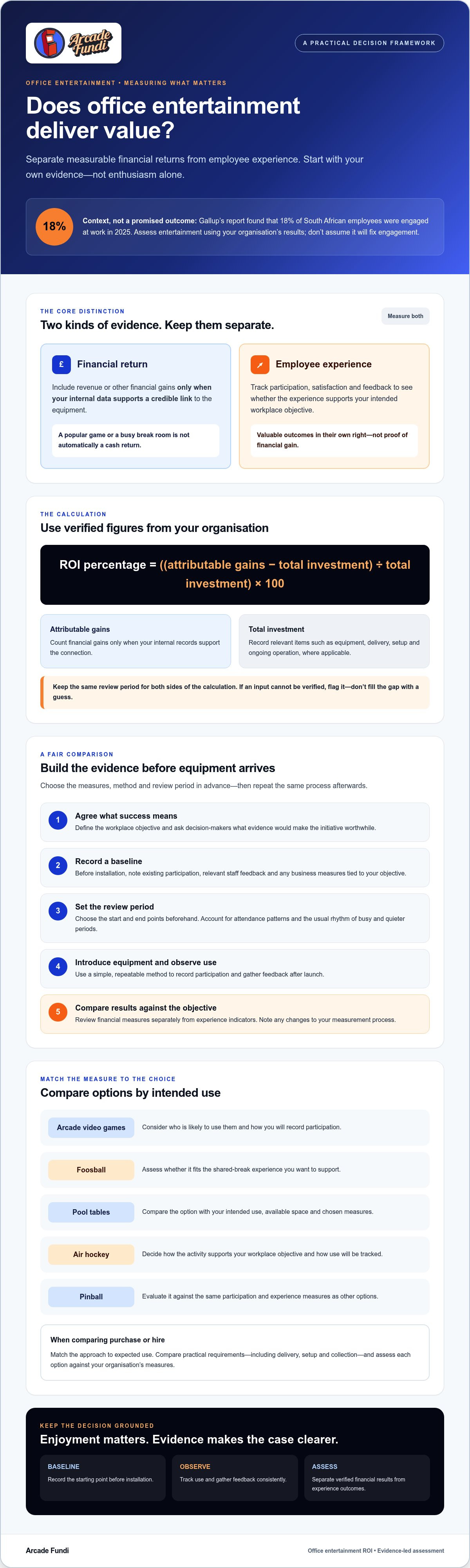
Office entertainment ROI compares financial gains you can reasonably attribute to the equipment with the total investment made to achieve them; it doesn’t promise that every benefit will produce a measurable financial return. This applies the basic idea behind Return on Investment (ROI) to a workplace decision. The key is attribution: a result counts as a financial gain only when your organisation can make a credible link between it and the entertainment initiative.
What counts as office entertainment ROI?
For calculating ROI on office entertainment, keep financial returns separate from employee experience. Record revenue or other financial gains only if your internal data supports a clear connection to the equipment. Don’t treat a popular game, positive comments or higher participation as cash returns by default.
Engagement, satisfaction and participation still matter. They can show whether the equipment is being used and whether it supports the workplace experience you intended. They’re outcomes in their own right, and may be useful longer-term indicators, but they don’t automatically prove financial gains. Your measures should follow your organisation’s purpose, whether that’s encouraging shared breaks, supporting staff experience or meeting another defined objective.
Which business question should your calculation answer?
Begin with the decision you need to make. Are you aiming to create a more welcoming staff area, encourage colleagues to spend breaks together, or meet another stated workplace objective? A clear answer helps you choose relevant measures and avoid collecting data that won’t guide the equipment decision.
Ask decision-makers what evidence would make the initiative worthwhile. They might look for regular participation, improved survey feedback or a financial result that can be linked to the equipment. Agree which outcomes are essential, which are supporting indicators and how you’ll interpret mixed results. That way, enjoyment remains part of the picture without being mistaken for proof of financial return.
Set the review period before selecting or introducing equipment. Choose a timeframe that gives employees a fair chance to try it and gives you a consistent basis for comparing results. Record the start and end points in advance, then assess the findings against the agreed objective. A clear review plan turns nostalgia and friendly competition into something you can evaluate, not just celebrate.
How to calculate ROI on office entertainment with your own data
Use your organisation’s verified figures, not industry estimates or invented examples. The calculation gives you a consistent way to compare attributable financial gains with the full investment recorded for the initiative. Keep employee experience measures alongside the calculation, but don’t quietly convert positive feedback or busy game sessions into financial gains.
ROI percentage = ((attributable gains − total investment) ÷ total investment) × 100. Use the same review period for both sides of the equation. Your investment record may include the equipment, delivery, setup and ongoing operation, where applicable. Gather the relevant figures from your own records and include only items that belong to the initiative. If you can’t verify an input, flag it rather than filling the gap with a guess.
Set a baseline and choose a review period
“Record your baseline before installation, or you won’t have a reliable before-and-after comparison.” Before the equipment arrives, note existing participation in shared break activities, relevant staff feedback and any business measures linked to your objective. Choose a simple, repeatable way to record each measure, then use that same method after launch.
Set the review period in advance. It should reflect how your office normally operates, including attendance patterns and the rhythm of busy and quieter periods. A period that misses a typical working pattern could give you a distorted picture of use. Record any changes to your measurement process so comparisons stay fair.
Attribute benefits carefully and avoid false precision
Only include direct revenue if your office model generates it and your organisation records it. For example, if equipment is available for free play and doesn’t generate tracked revenue, don’t assign it a revenue figure simply to complete the formula. Follow the purpose you set for the initiative and report participation, satisfaction or engagement separately where these are relevant.
Be just as careful with claimed productivity benefits. Don’t assign a monetary value to improved focus, satisfaction or fewer interruptions unless your organisation has a defensible method and verified data to support that conversion. If your internal measures suggest a change, describe what changed and how you measured it before making a financial claim.
Keep a short record of other factors during the review period, such as changes in attendance, office routines or team arrangements. These may influence participation or business measures, so they matter when you interpret the result. A transparent calculation is more useful than a precise-looking figure that hides uncertainty.
Once your measurement plan is clear, check that the equipment suits your office and how you’ll evaluate it. Explore office entertainment equipment from Arcade Fundi, which offers equipment for purchase or hire.
Which office entertainment option best fits your ROI measures?
The best choice isn’t automatically the most eye-catching game. It’s the one that suits your office routines, available space and staff preferences, and gives you a practical way to measure participation. As you’re calculating ROI on office entertainment, shortlist equipment based on the experience you want to create, then decide how you’ll record use before making a selection.
Match equipment to the way your team uses shared spaces
Ask employees whether they’d prefer quick rounds, longer games or a mix. Gather feedback before settling on a category, and check the proposed location for space, access and room for people to gather or play comfortably. If your space also incorporates video displays or console gaming alongside traditional tables, commercial equipment providers such as HDTV Supply can supply the necessary audio-visual hardware. The table offers a starting point for comparing options, not a substitute for checking your own office layout.
| Equipment | Use case and likely users | Space to consider | Measurable participation |
|---|---|---|---|
| Arcade video games | Short, nostalgic play for individuals or colleagues taking turns. | Cabinet placement, access and room to queue or watch. | Record play sessions or distinct players. |
| Pool tables | A social option for colleagues who enjoy a longer, shared game. | Allow room around the table for players to move and take shots. | Log games played or participating groups. |
| Foosball | Fast, head-to-head play that can suit a quick shared break. | Check clearance around the table for players and movement. | Count matches or participants. |
| Air hockey | Energetic, competitive play for colleagues who want a lively match. | Consider the table footprint and space for players on both sides. | Track matches or usage periods. |
| Pinball machines | Individual turns and friendly score challenges for fans of classic arcade play. | Plan for cabinet placement and comfortable access. | Record turns, sessions or repeat participation. |
Compare buying and hiring as different commitment models
Buying may suit an office expecting long-term use, provided you’ve considered ongoing operation and ownership responsibilities. Hiring may fit a defined trial or temporary workplace need, especially if you want to assess use before deciding on a longer-term arrangement. Neither route guarantees a better result. Compare them against the same review period, participation method and workplace objective.
Look beyond the initial excitement. If staff use the equipment regularly and feedback supports your objective, that’s useful evidence of fit. If participation is limited, consider whether the location, office routine or type of play affected results before drawing conclusions. Arcade Fundi sells and rents office entertainment equipment across South Africa, including arcade video games, pool tables, foosball, air hockey and pinball machines.
How to track office entertainment use and evaluate results
A simple tracking routine can show whether office entertainment is being used and whether it supports the objective you set. Keep the process consistent from the first note to the final review. You don’t need elaborate analytics: a shared log, a short staff survey and a clear link to your original goal can give you useful evidence for calculating ROI on office entertainment.
- Record the baseline: Note existing participation, relevant staff feedback and the business measures you chose before launch.
- Launch: Make the equipment available and tell employees how it fits into the shared space.
- Observe: Use a simple log to record sessions, matches or active users. Choose one method that suits the equipment and workplace, and apply it consistently.
- Survey: Ask a few brief questions about awareness, participation and experience.
- Review: Compare results with the baseline and your original objective, then decide what to do next.
Choose practical measures your team can maintain
Pick a small set of indicators before launch. For example, track equipment sessions alongside a short staff question about whether the shared space encourages enjoyable breaks. Use the same wording and collection method at each review point, so changes are easier to interpret.
Keep participation records simple and avoid collecting identifying details unless you have a clear reason. Where appropriate, report survey responses and usage at group level. This can help employees share honest feedback without turning a friendly game into individual performance monitoring. Of course, maintaining robust oversight of workplace data and digital infrastructure is a fundamental business priority, with cybersecurity specialists such as CyberOne helping organisations protect their connected environments through managed detection and response.
Use results to decide whether to continue, adjust or change
Compare actual use with the expectations agreed before equipment selection. If participation is lower than expected, investigate before deciding the equipment has failed. Is it easy to notice and access? Do employees know it’s available? Does the type of play suit their preferences and break patterns? Staff feedback can point to a practical adjustment or a better fit.
Record changes that may have influenced results, such as different office attendance, team routines or other workplace initiatives. These factors can affect both use and business measures, so don’t claim the equipment caused a change unless the evidence supports that conclusion.
In your review, state the objective, what you measured, what changed, any limitations and the next step. You might continue, adjust the setup or reconsider the option, depending on the evidence. Ready to assess equipment choices for your workplace? Explore office entertainment equipment from Arcade Fundi, which serves customers across South Africa.
Turn your office entertainment ROI plan into an equipment decision
You’ve set an objective, chosen measures and decided when to review results. Now turn that plan into a practical brief. It helps you compare equipment and suppliers on the details that affect day-to-day use, not just the first burst of excitement when a new game arrives.
- Objective: State the workplace experience you want to support, such as shared breaks or a more engaging staff area.
- Baseline: Note your starting participation, relevant employee feedback and any business measures you’ll assess.
- Space: Describe the intended location and the room available for the equipment and people using it.
- Expected use: Explain who is likely to play, how often the space is used and whether staff prefer quick rounds or longer games.
- Review date: Set when you’ll assess participation and outcomes, using the same approach agreed before launch.
Prepare a clear brief before speaking with suppliers
Include the experience you want to create, likely users and space details in your brief. Say whether you’re considering a purchase for expected long-term use or a rental for a defined trial or temporary need. This gives suppliers useful context to discuss suitable equipment, rather than leaving the choice to guesswork.
Ask each supplier about equipment fit, delivery, setup and collection, along with servicing and other after-sales arrangements relevant to your plan. Confirm what is included and who is responsible for each step. Comparing the same points across suppliers makes it easier to assess the practical experience as well as the equipment itself.
Explore office entertainment equipment with Arcade Fundi
Arcade Fundi offers arcade entertainment equipment for purchase or hire to customers across South Africa. Its range includes arcade video games, pool tables, foosball, air hockey and pinball machines. When discussing options, ask about the arrangements that matter to your plan, such as delivery, setup, collection and any ongoing responsibilities. Your results will depend on your office’s objectives, equipment use and chosen measures.
Share your brief and ask about suitable arcade video games, pool tables, foosball tables, air hockey tables or pinball machines. Check the current range and availability as you discuss options. Then compare the recommendations against your space, expected use and review plan before deciding.
Ready to take the next step? Explore office entertainment equipment with Arcade Fundi and discuss options for your workplace. With a clear brief in hand, you can choose an experience your team will enjoy and evaluate it against the goals you set.
Make your next office entertainment decision with confidence
Calculating ROI on office entertainment starts with a clear objective, a recorded baseline and measures you can repeat. Track financial gains only when your organisation can link them to the equipment, and assess employee feedback and participation as valuable outcomes in their own right. Choose arcade games, pool, foosball, air hockey or pinball to suit your team’s preferences, shared spaces and expected use.
With your review criteria in place, you can compare purchase and rental options against the same workplace goals. The right choice is the one that fits your office and gives you a fair way to evaluate the experience, not one that promises a guaranteed return.
Arcade Fundi sells and rents arcade entertainment equipment to customers across South Africa. Explore office entertainment equipment with Arcade Fundi and discuss options for your workplace. Give your team a little friendly competition and build your decision on evidence.
Frequently Asked Questions
How do you calculate ROI on office entertainment?
Calculate ROI by subtracting total investment from attributable financial gains, dividing the result by total investment, then multiplying by 100 to get a percentage. For calculating ROI on office entertainment, use verified figures from your organisation and include relevant investment inputs, such as equipment, delivery, setup and ongoing operation. Count a financial gain only if you can reasonably link it to the equipment. Report employee experience measures separately.
Can office entertainment improve employee productivity?
Office entertainment may support enjoyable breaks and social connection, but it doesn’t guarantee improved productivity. Treat productivity as an outcome to assess, not a promised result. Before introducing equipment, choose relevant indicators your organisation already tracks, such as completed projects, work errors or staff-reported focus. Compare them before and after launch, and consider other workplace changes that could have influenced the results.
What should you measure when evaluating office entertainment?
Measure equipment use and outcomes that match your stated workplace objective. You could record sessions, games or participating groups, then pair those figures with short staff feedback on enjoyment or satisfaction. If relevant, review existing business measures such as unplanned absence or project completion. Set your indicators in advance and keep financial gains separate from participation and employee experience unless you have a sound basis to connect them.
How long should you track office entertainment ROI?
Choose a review period before equipment is introduced, rather than relying on a fixed timeframe that may not suit your office. Allow for typical attendance patterns and the way employees use shared spaces, then compare results at planned review points. Use the same tracking method throughout. If attendance or office routines change during the period, record that context before drawing conclusions about use or outcomes.
Is renting office entertainment equipment better than buying it?
Neither option is automatically better. Buying may suit an office expecting long-term use and prepared to take on ownership responsibilities. Renting may fit a defined trial or temporary workplace need. Compare both against your expected use, evaluation period and the same participation and outcome measures. Arcade Fundi sells and rents entertainment equipment across South Africa, so you can explore which arrangement fits your plan.
Which arcade games are suitable for an office?
Choose arcade video games that suit your team’s preferences, shared-space routines and available room. Ask staff whether they favour quick turns, friendly competition or taking turns between other activities. Consider who is likely to play and how you’ll record participation. Arcade video games are one option; pool, foosball, air hockey and pinball can also suit different office entertainment plans.
How can you measure employee engagement from office entertainment?
Use a short, consistent staff survey before and after introducing the equipment. Ask questions linked to your objective, such as whether employees feel supported in managing their wellbeing at work or whether shared breaks help them connect with colleagues. Use the same wording and collection method each time, and report responses at group level where appropriate. Survey feedback can indicate experience, but it doesn’t by itself prove financial return.