

That table may fit your floor plan, but can you take a full shot without nudging the wall? A compact pool table for small room use needs more than a small footprint: cue movement around every side matters just as much. It’s easy to picture relaxed games at home, only to find that tight clearance interrupts the fun.
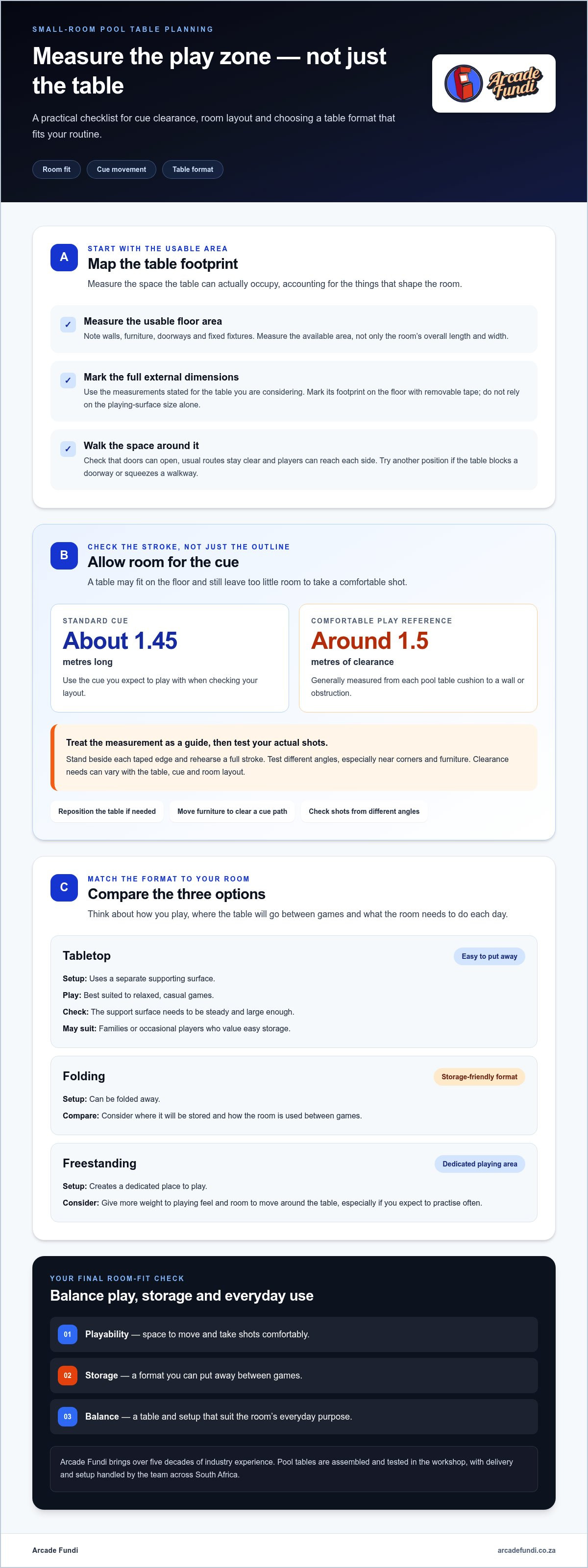
Measure the playable space before choosing a size or style. A standard cue is about 1.45 metres long, and comfortable play generally calls for around 1.5 metres of clearance from each pool table cushion to a wall or obstruction. In this guide, you’ll learn how to measure that space, compare tabletop, folding and freestanding options, and weigh storage against the feel of the game. You’ll also see when a shorter cue could help with shots near a wall.
Arcade Fundi brings over five decades of industry experience to pool tables. Products are assembled and tested in the workshop, and the team handles delivery and setup across South Africa. Get the measurements right, and you can choose a table that brings nostalgia and friendly competition home without crowding your room!
Key Takeaways
- Choose a compact pool table for small room use by thinking about the shots you can comfortably play, not just the space the table occupies.
- Map the table area on your floor and account for furniture, doorways and fixed fixtures before settling on a format.
- Compare tabletop, folding and freestanding options by how you’ll play, where you’ll store the table and how the room is used day to day.
- Plan access and storage alongside your play area so the room can switch smoothly between game time and its usual routine.
- Arcade Fundi brings over five decades of industry experience, with nationwide delivery and setup handled by the team.
What to consider before choosing a compact pool table for a small room
A table can fit neatly against a wall and still leave you with nowhere to take a shot. That’s the space-versus-playability challenge: choose a compact pool table for small room use by considering the space around it, not just its footprint. “Compact” might mean a tabletop game, a folding format or a smaller playing surface. Each suits a different room and routine.
Start with how you want to play. Occasional family games in a shared living space call for different priorities from frequent practice, where comfortable movement and a more dedicated setup matter. Picture a full game before choosing: where players will stand, how they’ll move around the table and what needs to be shifted or stored.
What does compact mean for a pool table?
Compact isn’t one fixed size. It describes how a table fits your room, its format and the way you’ll use it. A tabletop model can make use of an existing surface and be put away when play is over, while a freestanding table creates a dedicated playing area. Neither is automatically the better choice; the right fit depends on your available space and expectations.
Dimensions vary between models, so use the stated measurements for the table you’re considering rather than relying on labels such as “mini” or “small”. Distinguish the playing surface from the table’s full external dimensions, too. For background on standard pool table dimensions and table construction, see Wikipedia’s overview.
Who is a small-room pool table for?
A smaller format can suit a family looking for relaxed games with friends in a shared living room. If play is occasional, easy storage or keeping the room flexible may matter most. A tabletop option may suit that routine, provided you have a steady, suitable surface to support it during play.
If you expect to practise often, give more weight to the feel of play and the room you’ll have to move around the table. Restricted movement can interrupt shots and make regular games less satisfying. Decide which matters most to you:
- Playability: space to move and take shots comfortably.
- Storage: a format you can put away between games.
- Balance: a table and setup that suit both play and the room’s everyday purpose.
Once you know your priority, assess the whole playing area before settling on a table footprint. That helps you choose for the game you’ll actually enjoy, not just the table that appears to fit!
Measure your room for a compact pool table and cue clearance
A floor plan can look generous until a player steps up for a shot. Before choosing a compact pool table for small room use, map the space where it will stand and test whether players can move around it and swing a cue. Measure the usable area, not just the room’s overall length and width. Walls, furniture, doorways and fixed fixtures can all affect the playing space.
How to map out the table footprint
First, measure the available floor area and note anything that can’t be moved. Use the full external dimensions stated for the table to mark its proposed footprint with removable tape. This shows how it sits alongside walls and furniture, rather than leaving you to rely on a rough estimate or the playing-surface measurements alone.
Walk around the marked area. Check that doors can open, usual routes through the room stay clear and players can reach each side. If the table would block a doorway or squeeze a walkway, try another position before settling on its footprint.
- Measure: record the usable floor area and note obstacles.
- Mark: tape out the table’s stated external dimensions.
- Check: walk the routes around it and test access to doors.
How to check cue space around the table
A taped outline shows where the table ends, not where a player needs to stand. Use the intended table and cue specifications to assess clearance. Stand beside each marked edge with the cue you expect to use, then rehearse a full stroke without hitting a wall, chair or other obstruction. Pay particular attention to corners and the sides nearest furniture.
Test likely shots from different angles, too. You may have room to stand beside one rail but find a shot awkward when the cue points towards a wall. If the cue is restricted, see whether repositioning the table or moving furniture creates a clearer path. Don’t assume one fixed clearance will suit every table, cue and room layout.
Commit to a position only when the taped footprint and shot tests work together. If your measurements point to a freestanding table, you can explore Arcade Fundi’s pool tables as your next step.
Compare tabletop, folding and freestanding compact pool table options
The right format depends on how you’ll play and what the room needs to do between games. A tabletop version is easy to put away, a folding table can make storage simpler, and a freestanding table gives you a dedicated place to play. Compare the trade-offs before choosing a compact pool table for small room use.
| Format | Footprint and storage | Play experience | Often suits |
|---|---|---|---|
| Tabletop | Uses a separate supporting surface and can be stored between sessions. | Best suited to relaxed, casual games; the support surface needs to be steady and large enough. | Families or occasional players who value easy storage. |
| Folding | Can be folded away, but needs room to open, play and store. | Offers a dedicated table during play; setup and stability matter. | Players who want a freestanding format but need to reclaim floor space. |
| Freestanding | Occupies a more permanent position and needs a suitable playing area. | Creates a ready-to-play spot for regular games. | Households with space for a lasting game area. |
Tabletop pool tables: smallest footprint, casual play
A tabletop model sits on another surface, such as a sturdy table. That makes the game easy to put away, but you’ll still need somewhere suitable to set it up and store it. Check that the support is level, stable and clear of items before play. This format can bring friends and family together for a quick game without claiming a permanent place in the room. Its convenience suits casual play, though it may not be the right choice if you want frequent practice.
Folding and freestanding tables: storage versus everyday play
A folding table offers a middle ground: you can put it away, but it still needs enough room to stand open and be played on comfortably. Think through the full routine, including setting it up, checking that it feels stable during play and finding a storage spot afterwards.
A freestanding table suits a room where you can leave the game ready between sessions. It needs a more lasting playing area, so consider whether that space works with everyday furniture and movement. Your taped floor plan can help you compare the table in use with the space each format saves when stored. Choose for your real routine, and make room for the kind of game you’ll enjoy playing!
Plan a small-room pool table setup that works day to day
A good setup has to work on game night and on an ordinary weekday. Before placing a compact pool table for small room use, decide where it can sit without making the room awkward to walk through or disrupting activities your household uses every day. A little planning helps the game feel like a welcome addition, not an obstacle.
Use this simple sequence to shape the layout:
- Choose the play area: pick a position that gives players access around the table and keeps likely shots clear of walls and furniture.
- Check access: walk the usual routes through the room and make sure doors and shared spaces remain easy to use.
- Test the setup: place the table outline, then consider how players will stand and move during a game.
- Plan storage: if the table moves between sessions, decide where it will go and how you’ll get it there.
Arrange furniture around the playing area
Keep the marked play zone clear of furniture that could block common shots. In a shared living room, check the route between the entrance, seating and other everyday areas as well as the path around the table. A chair that’s easy to shift may be manageable; a large piece that interrupts every game can quickly become frustrating.
Think about how often you’re willing to rearrange the room. If you’ll move a coffee table before play and return it afterwards, make sure that feels practical for everyone at home. If repeated changes would be a chore, choose a layout that keeps the playing area and main walking routes working together from the start.
Make storage and room use part of the decision
For a folding or tabletop format, identify its storage spot before choosing a table. Consider the complete routine: will you need to lift or carry it, clear a shelf or move other items first? A storage plan that works on paper should also feel simple enough to follow after a game.
Think ahead to the room’s usual purpose, too. You might set up for a match with family or friends, then restore the space for relaxing or another household activity. If you’re still comparing table choices, read Arcade Fundi’s pool tables for sale South Africa buyer’s guide for more buying guidance. Ready to find a table for your home entertainment setup? Explore Arcade Fundi’s pool tables and picture your next great game!
Choose your small-room pool table with Arcade Fundi
You’ve measured the room, considered cue movement and weighed up how much space you can give to the game. Now bring those details together. The right choice isn’t simply the table that takes up the least floor space; it’s the format that fits your playing area and suits how you’ll use the room day to day.
Use your room measurements to narrow the choice
Review your usable floor area alongside the table’s stated dimensions and the room needed around it for shots. Then factor in storage and how often you expect to play. These priorities can point you towards a tabletop format for occasional games and easy storage, a folding option if you want to reclaim floor space after play, or a freestanding table if you have a suitable area for a regular game setup.
Think about the trade-offs as a whole. A table that stores away may still need a clear place to be set up, while a freestanding format occupies space between games. If you’ll play often, give comfortable movement more weight. If the room has several everyday uses, consider how easily the game can be packed away or the furniture rearranged. Let your room plan guide the choice, rather than a compact label alone.
Start with your measurements and playing routine, then explore pool tables with those requirements in mind. Arcade Fundi brings over five decades of industry experience, and products are assembled and tested in the workshop.
Bring the game home with Arcade Fundi
Ready to make room for friendly competition and a little nostalgia? Arcade Fundi sells pool tables and serves customers nationwide across South Africa. Delivery, setup and collection are handled by the team, helping you plan the move from choosing a table to getting your game space ready.
Explore pool tables with Arcade Fundi and find the right starting point for your home entertainment setup!
Make room for your next great game
The best compact pool table for small room use is one that leaves space for comfortable shots and fits the way you live. Measure the playing area, test cue movement and factor in furniture and walkways before choosing. Then weigh up whether a tabletop, folding or freestanding format suits your play habits, storage needs and available space.
Those checks help you choose for the game you’ll actually enjoy, whether that means relaxed family matches or a more regular practice routine. Arcade Fundi brings over five decades of industry experience to its pool tables, with products assembled and tested in the workshop. The team handles delivery, setup and collection, with nationwide delivery across South Africa.
Ready to bring a little nostalgia and friendly competition home? Explore pool tables with Arcade Fundi and take the next step towards a setup that fits your room and routine. Your next great game could be closer than you think!
Frequently Asked Questions
How much room do you need around a compact pool table?
For comfortable play with a standard cue, allow about 1.5 metres of clearance from each pool table cushion to a wall or obstruction. A standard cue is around 1.45 metres long, giving a player room to take a full stroke. Measure from the cushion, not the table’s outside edge. If space is tight, a shorter cue may help with some shots, though it won’t remove the need to test movement around the table.
Can you play properly on a tabletop pool table?
Yes, a tabletop pool table can be great fun for casual games with family and friends. It sits on a separate surface, so choose a support that’s stable, level and large enough for the game. Its small format and easy storage make it convenient, but it won’t feel the same as playing on a freestanding table. If you want frequent practice, think about how its size and playing feel match your expectations.
Are folding pool tables suitable for small rooms?
They can suit a small room if you have enough space to set the table up and play comfortably, plus a suitable place to store it afterwards. Folding can make it easier to reclaim floor space, but remember that the table still occupies room while open. Consider how you’ll move and store it, and check that it feels stable when set up. The best fit depends on your layout and how often you’ll play.
What is the difference between a mini pool table and a standard pool table?
A mini pool table generally has a smaller playing surface or a different format, such as a tabletop version, whilst a standard pool table offers a larger playing area and needs more room for cue movement. “Mini” isn’t one fixed size, so compare the stated dimensions of each table rather than relying on its label. Also consider whether you want occasional, space-conscious games or a more dedicated setup for regular play.
How do you measure a room for a compact pool table?
Measure the usable floor area where the table could go, then mark the table’s full external dimensions on the floor with removable tape. Include furniture, walls, doorways and fixed fixtures in your plan. Next, test standing and taking shots around every side, paying particular attention to positions near walls or chairs. Check that people can still move through the room. Use the table and cue measurements for your specific choice, not assumptions based on its compact label.
Can a pool table fit in a living room?
Yes, if the room can accommodate the table and leave space for players to move and take shots without blocking everyday routes. Mark out the proposed position and check access to doors, seating and other shared areas. For a room with several uses, movable furniture or a format that can be stored may help. Think about whether changing the layout before and after games will feel manageable for your household.
What should you check before choosing a small-room pool table?
Check the usable floor area, the table’s stated external dimensions, cue clearance and how players will move around it. Then consider how often you’ll play, whether the room needs to serve other purposes and where a tabletop or folding format would be stored. These details help you compare options based on your routine, not just the footprint. Arcade Fundi brings over five decades of industry experience and delivers pool tables nationwide across South Africa.