

The most explosive break in the room doesn't come from the strongest arm; it starts with the tightest set. If you've ever watched a professional match, you know that the secret to a game-winning scatter lies in exactly how to rack pool balls with surgical precision. One tiny gap amongst the pack can turn a potential run-out into a frustrating cluster of dead balls. Whether you're hosting a high-stakes tournament on a professional slate-bed table or a casual Friday night with mates, mastering this foundational skill is the difference between a sloppy start and total table dominance.
We've all been there: arguing over whether the 8-ball goes in the centre or if the stripes should be at the back whilst the clock is ticking. It's frustrating when a loose rack ruins the momentum of a great evening and leaves you with an inconsistent break. This guide promises to settle those debates once and for all by teaching you the professional secrets to a rock-solid rack for every major variant. You'll learn the specific patterns for 8-ball and 9-ball, the nuances of British versus American sets, and the subtle tricks that ensure every ball is frozen for maximum impact. Let's transform your break from a dull thud into a thunderous, game-changing strike.
Key Takeaways
- Learn why positioning the apex ball exactly on the "foot spot" is essential for ensuring maximum energy transfer and an explosive scatter.
- Master the official 2026 rules for how to rack pool balls in both 8-ball and 9-ball variants to settle any social game disputes instantly.
- Discover professional techniques like the "Fingertip Press" and "Paper Test" to eliminate tiny gaps that cause inconsistent, weak breaks.
- Understand why a professional slate-bed table is the ultimate foundation for achieving a tight rack and predictable ball behaviour.
Why the Perfect Rack is the Foundation of Every Great Game
The thunderous crack of a perfect break is the most satisfying sound in any games room! But that explosive scatter doesn't happen by accident. It's the result of precision, patience, and a deep understanding of how to rack pool balls like a seasoned pro. If you've ever watched a championship match, you'll notice the players spend significant time ensuring every ball is frozen. Why? Because a professional setup isn't just about following the rules; it's about controlling the table from the very first strike. A sloppy rack leads to a sloppy game, but a tight, professional pack gives you the best chance of sinking a ball on the break.
Understanding the Foot Spot and Apex Ball
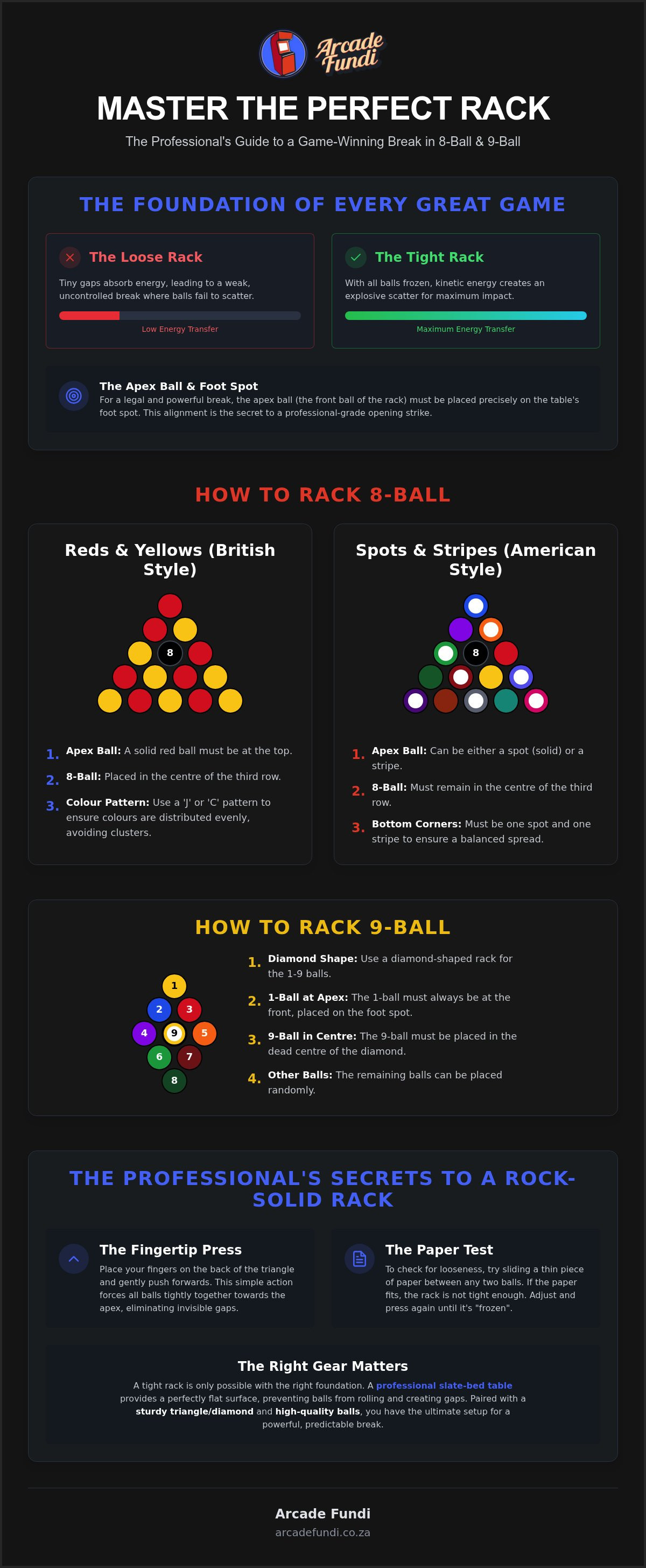
To get started, you need to find the foot spot. This is the precise point on the table where the long string and the short string intersect. If your table doesn't have a physical marker, look for the imaginary line between the second diamonds on the long rails. The apex ball is the lead point of the rack that faces the breaker. For a legal start, this lead ball must sit directly on the foot spot. Even a millimetre of misalignment can send your cue ball flying off in a wild direction, so take your time to centre it perfectly. Accuracy here is the secret to a professional-grade opening.
Energy Transfer and the Physics of the Break
Why does a tight rack matter so much? It's all about energy transfer. When the cue ball hits a loose rack, the energy is absorbed by the gaps; this results in a "dead" break where the balls barely move and stay clustered together. However, when the balls are touching, the kinetic energy travels through the entire pack instantly. This creates the "shatter" effect, sending balls flying towards the pockets with incredible speed. Professional slate-bed tables are essential here, as their perfectly flat surfaces prevent balls from rolling away or creating hidden gaps whilst you're trying to lock them into place.
Beyond the physics, a tidy rack gives you a massive psychological edge. It shows your opponent that you're a serious player who understands the nuances of the game. To achieve this, you'll need the right gear:
- A sturdy triangle: Essential for the classic 15-ball setup.
- A diamond rack: Specifically designed for the tighter 9-ball configuration.
- High-quality ball sets: Consistent weight and size are vital for a uniform pack.
A professional, tight setup commands respect and sets the tone for the entire match. Don't settle for a sloppy start when a little extra effort can guarantee a game-winning break!
Step-by-Step: Racking 8-Ball Pool for Reds, Yellows, and Stripes
Ready to set the stage for a legendary match? The way you arrange those spheres determines if the game is a tactical masterpiece or a messy scramble. Knowing how to rack pool balls correctly is the first step to command respect at the table. Whilst the 8-ball always sits in the dead centre of the third row, the rest of the layout depends on which version of the game you're playing. Mastering these specific patterns ensures every player gets a fair shot at the win.
The Reds and Yellows Pattern
In South Africa and the UK, the red and yellow set is the local standard. Start by placing a single red ball at the apex. From there, follow a "J" or "C" pattern to distribute the colours evenly around the triangle. This specific sequence organises the balls so they alternate effectively across the rows. It prevents frustrating "clusters" of the same colour, which can make the game feel unbalanced after the break. A professional rack should never have three balls of the same colour touching in a straight line. It's all about balance and ensuring a competitive spread! If you're serious about your home setup, using professional-grade pool tables provides the flat, consistent surface needed to keep this pattern perfect whilst you prepare to strike.
Spots and Stripes (American 8-Ball)
The American style uses a numbered set from 1 to 15. The rules here are slightly more flexible but no less vital for a high-quality game. The apex ball can be either a spot or a stripe; it's entirely your choice. However, the two bottom corner balls must be different from each other. If the left corner is a spot, the right must be a stripe. This ensures an even distribution of energy and variety across the cloth once the cue ball impacts the pack. Just like the British version, the black 8-ball must remain in the centre of the third row. This symmetry is what creates that iconic, professional look we all love in a classic pool hall.
Before you lift the triangle, do a quick visual sweep. Are the balls "frozen" and touching each other? Are the back corners diverse? A quick check on how to rack pool balls prevents the frustration of a "dead" break and keeps the competition fierce. You've now mastered the geometry of the 8-ball rack. It's time to step back, chalk up, and let the games begin!
Mastering the 9-Ball Diamond and Alternative Games
Whilst 8-ball remains the undisputed king of social gaming, 9-ball is the high-octane choice for those who crave speed and aggression. This game moves fast! Because you're only using nine balls, the traditional triangle isn't the best tool for the job. Instead, you'll want a diamond-shaped rack to ensure the balls stay perfectly aligned. Learning how to rack pool balls for this variant requires a slightly different approach, but the goal remains the same: a rock-solid pack that explodes upon impact.
In 9-ball competition, you'll often hear pros talk about a "slug-ish" rack. This doesn't mean it's slow; it means the balls are so tightly packed that they behave like a single, solid unit. If there's even a fraction of a millimetre between the balls, the energy from your break will dissipate. A tight diamond ensures that the 1-ball takes the full force of the cue ball, sending the rest of the pack into a predictable, high-speed scatter. It's a game of precision where the setup is just as important as the shot.
The 9-Ball Racking Sequence
Start by placing the 1-ball directly on the foot spot at the apex of the diamond. The 9-ball must sit in the very centre of the rack, surrounded by the other seven balls. Interestingly, official rules allow the remaining balls to be placed in any order, provided they are all touching. However, many seasoned players prefer to keep the 2-ball at the very back of the diamond to ensure it doesn't get buried in the initial cluster. The key is to press the balls forward from the back to eliminate any daylight between them. If they don't move when you give the rack a tiny nudge, you've nailed it.
Racking for 10-Ball and Snooker
If you're looking for an even greater challenge, 10-ball is becoming a firm favourite amongst serious enthusiasts. This game returns to the triangle rack but uses a unique 1-2-3-4 row structure. It's a more difficult break than 9-ball because the extra ball in the middle absorbs more energy. For those who prefer a truly classic experience, racking the 15 reds in Snooker is an art form of its own. These balls are smaller and lighter, requiring a steady hand to keep the pyramid perfectly aligned behind the pink ball. Mastering how to rack pool balls across these different formats makes you a versatile and respected host.
Choosing the right setup depends heavily on the space you have available and the type of competition you enjoy. Understanding your table's dimensions is crucial when moving between these different disciplines. For more on table size context and finding the perfect fit for your home or venue, take a look at Mastering the Cue: Buying a Pool Table in South Africa. Whether you're chasing a 9-ball run-out or a Snooker century, the perfect game always begins with a professional rack.
The Professional’s Secret: How to Ensure a Rock-Solid, Tight Rack
Even the most powerful break shot in the world will fail if the pack isn't frozen. A loose rack is the ultimate "power sponge"; it absorbs the kinetic energy you've worked so hard to generate. If you want to see the balls explode across the cloth, you must master the finer details of how to rack pool balls with absolute tension. Pros don't just throw the triangle down and walk away. They use specific tests to ensure every sphere is locked tight against its neighbour. One tiny gap can be the difference between a game-winning scatter and a frustrating cluster.
The "Paper Test" is the gold standard for checking your work. Try sliding a thin slip of paper between any two balls in the rack. If the paper passes through, the rack is loose and needs a reset. This usually happens because of worn-out balls or a dirty, high-nap cloth that prevents the balls from settling. Over time, balls can lose their perfect spherical shape by a fraction of a millimetre. If you're struggling to get a tight fit despite your best efforts, it might be time to invest in a fresh set of professional-grade balls or a cleaner table surface.
Techniques for a Tighter Fit
The "Fingertip Press" is the secret weapon of tournament directors. Place your thumbs on the back rail of the triangle and use your fingertips to pull the balls forward toward the apex. Simultaneously, give the rack a slight "push and pull" motion to ensure the lead ball is anchored on the foot spot. For those who demand 100% consistency, a "Magic Rack" (a thin plastic template) can eliminate human error entirely. Some players also "tap" the balls into place to create tiny dimples in the cloth. Whilst this helps the balls find their home, do it gently; you don't want to damage the slate or the felt!
Etiquette and Fair Play
Racking isn't just about physics; it's about the spirit of the game. The "Winner Racks" versus "Loser Racks" debate often depends on house rules, but in many professional circuits, the winner racks to prove they can still perform under pressure. When removing the triangle, lift it vertically with a steady hand. Sliding it across the cloth can disturb the balls and scuff the table surface. This behaviour protects the longevity of your equipment and maintains a professional atmosphere. Treat the gear with respect to keep the game fast and fair. Ready to bring this level of precision to your own home? Explore our range of professional pool tables to ensure every break is a masterpiece.
Level Up Your Leisure: Choosing Professional Tables and Accessories
You've mastered the technique, but is your equipment holding you back? A world-class break requires more than just knowing how to rack pool balls; it needs a surface that responds to your precision. Imagine the frustration of balls rolling away before you even lift the triangle! High-end recreation is all about the details. From the tactile weight of the balls to the density of the table bed, every component contributes to that satisfying, thunderous crack of a perfect opening shot. If you're serious about your game, it's time to look at the hardware that makes it possible.
Slate-Bed vs. MDF: Does it Affect the Rack?
MDF (Medium Density Fibreboard) might work for a quick game in the garage, but serious players know its limits. Over time, moisture and heat can cause MDF to warp, creating subtle dips that ruin your alignment. When the surface isn't true, achieving a rock-solid rack becomes an impossible task. Slate-bed tables are the undisputed gold standard for a reason. They provide a perfectly flat, heavy foundation that keeps every ball frozen exactly where you place it. This precision is why professional venues never settle for anything less. They are built for longevity and peak performance in both commercial and home environments. For a deep dive into selecting the right hardware for your home, read Pool Tables for Sale South Africa: The Ultimate Buyer’s Guide 2026.
Don't let a flimsy rack spoil your setup. Cheap plastic triangles often flex and bend, which makes how to rack pool balls a chore rather than a ritual. Upgrading to a wooden or heavy-duty aluminium rack provides the rigidity needed for a consistent, tight fit every single time. It’s a small change that makes a massive difference in the quality of your break and the overall feel of your game room.
Planning Your Perfect Game Room
Planning a corporate event or building the ultimate home arcade? You need a partner who shares your passion for play. Arcade Fundi is a national supplier of professional pool tables and high-end entertainment equipment. We don't just sell gear; we facilitate joy and competition. Our team organises national delivery and professional setup, ensuring your table is perfectly levelled and ready for action. Whether you're looking for permanent installations or top-tier event rentals, we have the expertise to elevate your atmosphere. Ready to transform your leisure time? Explore Arcade Fundi entertainment solutions and start your journey toward gaming mastery today!
Step Up to the Table and Break Like a Pro
You've now unlocked the secrets to a championship-level start. From mastering the specific patterns of reds and yellows to ensuring a rock-solid diamond for 9-ball, you're ready to dominate your next match. Remember that the secret to an explosive break isn't just raw power; it's the precision of a frozen pack. Knowing exactly how to rack pool balls with professional tension ensures that every ounce of energy from your cue ball shatters the pack with maximum impact.
Don't let subpar equipment dampen your competitive spirit. Whether you're looking for a permanent home setup or a high-end rental for a corporate event, we've got you covered. Discover Professional Pool Tables and Arcade Gear at Arcade Fundi and experience the difference that a professional slate-bed table makes. Trusted by corporate clients nationwide, we provide expert setup and national delivery across South Africa to ensure your game is always top-tier. It's time to chalk up, take your stance, and let that first crack of the balls announce your mastery of the table!
Frequently Asked Questions
Where does the 8-ball go in the rack?
The 8-ball must always sit in the centre of the third row. It is the only universal constant across all 8-ball variations. You should surround it with other balls to ensure it is completely isolated from the edges of the triangle. This specific placement ensures the black ball doesn't fly into a pocket immediately during a standard break. Keeping it central follows official 2026 tournament regulations and maintains a competitive, fair game for everyone at the table.
Do pool balls have to be in a certain order?
Yes, specific patterns are required to prevent clusters and ensure a fair game. In British reds and yellows, you should use a "J" pattern to alternate the colours effectively. In American spots and stripes, the two bottom corners must be different, meaning one spot and one stripe. Following these rules for how to rack pool balls ensures an even spread across the cloth. Avoid placing three of the same colour together to maintain a balanced match.
How do you rack pool balls for 9-ball?
You must use a diamond-shaped rack instead of a triangle for this fast-paced variant. Place the 1-ball at the very front apex on the foot spot, whilst the 9-ball sits in the dead centre of the diamond. All other balls can be placed randomly around the 9-ball, provided they are all touching. A rock-solid fit is crucial here because 9-ball relies on high-speed energy transfer to scatter the smaller pack effectively across your professional table surface.
What is the "Foot Spot" on a pool table?
The foot spot is the precise point where the lead ball of your rack must sit. It is located at the intersection of the long and short strings, usually marked by a small black dot or a cloth reinforcement. If your table lacks a physical marker, it is exactly halfway between the second diamonds on the long rails. Aligning the apex ball perfectly on this spot is the first step toward a professional, legal break that commands respect.
Why is it so hard to get a tight rack on my pool table?
Inconsistent racking is usually caused by a worn-out cloth or a non-slate bed that has warped over time. MDF tables can develop tiny "valleys" that pull the balls apart, making a frozen pack impossible. Additionally, if your balls are chipped or dirty, they won't sit flush against each other. Upgrading to a professional slate-bed table from a national supplier ensures a perfectly flat surface, making it effortless to lock the balls together for that satisfying shatter.
Is it better to use a plastic or wooden triangle for racking?
A wooden or heavy-duty aluminium triangle is far superior to cheap plastic versions for serious play. Plastic racks tend to flex and warp, which creates tiny gaps between the balls whilst you are trying to set them. A rigid wooden rack maintains its shape, allowing you to apply the "Fingertip Press" technique with much more control. This professional-grade gear is essential for anyone wanting to achieve a rock-solid pack every time they step up.
Who is supposed to rack the balls in a standard game?
In casual games, the loser of the previous frame typically racks for the winner. However, many professional 2026 tournament formats use "Winner Racks" to keep the game moving quickly and test the player's consistency. It is always best to agree on "house rules" before the first break to avoid any mid-game arguments. Regardless of who does it, the goal is always the same: a fair, tight setup that gives both competitors a clean shot.
What happens if the balls move when I lift the rack?
If the balls shift or roll away when you lift the triangle, you must reset the rack immediately. A loose setup ruins the physics of the break and gives the player an unfair disadvantage. To prevent this, lift the rack vertically with a steady hand instead of sliding it across the felt. If the balls continue to roll, check that your table is perfectly level, as even a minor tilt can make how to rack pool balls a nightmare.