

What if the best staff room isn’t the one packed with activities, but the one where everyone can find a break that suits them? The right employee recreation room ideas can turn an overlooked corner into a place to reset, share a laugh or challenge a colleague to a quick game.
You know a good break matters, but choosing activities for different tastes can be tricky. A lively game may draw one group in, whilst others want somewhere calmer to unwind. And even the most appealing room won’t help if it doesn’t fit your space or suit the way your team actually takes breaks.
This guide explores practical ways to balance play, social connection and quieter downtime, with ideas for arranging activities so the room feels welcoming and gets used. From arcade games and table games to thoughtful choices for compact spaces, you’ll find inspiration to shape a room around your colleagues.
Key Takeaways
- Choose employee recreation room ideas around the breaks your colleagues enjoy, from a quiet pause to a friendly challenge.
- Explore 12 options, including a calm corner, lounge seating, arcade video games and pinball.
- Balance low-noise, active and group activities so the room works for different preferences and available space.
- Gather staff suggestions, plan the layout, introduce the room and review what people use.
- Consider arcade games, pool, foosball, air hockey, pinball or a jukebox to bring more play into the space.
Employee recreation room ideas: start with the kind of break your team needs
A staff room can have all the right furniture and still feel like an unused spare room if it gives people no clear reason to settle in. Start by deciding which breaks you want the space to support: a quiet pause, a catch-up with colleagues or a quick burst of friendly competition. A considered mix of employee recreation room ideas gives people options without asking the room to be everything to everyone at once.
Think of the space as a shared setting for informal connection, play or a few peaceful minutes away from a desk. Recreation rooms can serve different purposes and include different activities, as the general overview of a recreation room explains. For a workplace, the useful question is which experiences suit your colleagues and fit the time they have. A quick card game may work during a short pause; a pool match can invite people to linger and chat.
Ideas for quick, low-pressure breaks
Make it easy to step in, take a breath and step out again. Comfortable seating, a small reading nook and a clearly defined spot away from the main activity can create a calmer option. Add tabletop diversions that need little explanation, so colleagues can join in without committing to a long game.
- Comfortable chairs: A welcoming place to sit suits someone looking for a quiet moment or an informal chat. Keep a clear route past the seating so it doesn’t become an obstacle.
- Reading nook: A small shelf of books or magazines offers a screen-free pause. Place it away from the busiest part of the room and keep the selection easy to browse.
- Tabletop games: Cards, dominoes or a simple puzzle give colleagues an easy shared activity. Store each game with its pieces together so it’s ready to pick up and simple to put away.
These are options, not guaranteed routes to better wellbeing or productivity. The aim is to make a quieter break feel just as welcome as a lively one.
Ideas for social play and friendly competition
For colleagues who enjoy a little action, choose activities with clear, familiar ways to join. A foosball table or air hockey table can spark short matches, whilst arcade video games offer nostalgic, pick-up-and-play entertainment. A pool table creates a more relaxed pace, giving players time to talk and take turns.
- Foosball or air hockey: Set aside enough room for players to move and for others to watch without blocking a walkway or doorway.
- Arcade video games: A familiar game can invite someone to play a quick round, whether solo or alongside a colleague. Choose a position where players can take turns without crowding other activities.
- Pool: A game unfolds at an easy pace, making it a natural fit for conversation between turns. Allow room around the table for players to take their shots comfortably.
You don’t need to fill every corner. Choose activities that give colleagues different ways to use the room, then leave enough space to move between them. That balance helps the room feel like a shared workplace break space, not a games room with only one kind of welcome!
12 Employee recreation room ideas for different moods and interests
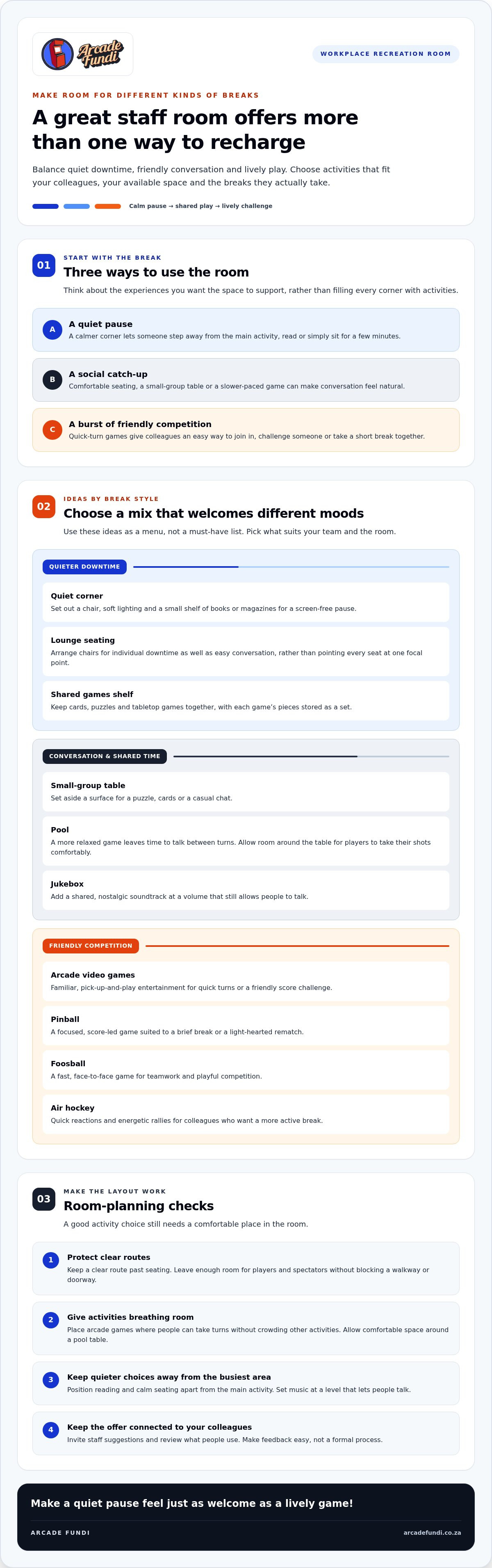
The strongest employee recreation room ideas offer choice: a place to switch off quietly, share a laugh or chase a high score. Use this roundup as a menu, not a must-have list. Pick options that suit your team, the room and the kinds of breaks colleagues want.
Games that make it easy to connect
Choose games with different levels of energy. Arcade video games invite quick turns and casual challenges, whilst pinball offers a focused, score-led game for a short pause. Foosball and air hockey bring players face to face for lively matches. Pool is another option, with a more relaxed pace that leaves room for conversation between turns.
Spaces for unwinding and shared downtime
Balance the action with comfortable seating arranged for both solo pauses and small-group conversation. A jukebox can add a shared soundtrack, provided its volume suits the room and its neighbours. Keep a visible suggestion board nearby, too, so colleagues can share activity ideas or flag a simple improvement without turning feedback into a formal process.
- Quiet corner: Create a calmer spot with a chair, soft lighting and a small shelf of books or magazines for a screen-free pause.
- Lounge seating: Arrange chairs to support both individual downtime and easy conversation, rather than pointing every seat at one focal point.
- Arcade video games: Offer familiar, pick-up-and-play entertainment where colleagues can take quick turns or start a friendly score challenge.
- Pinball: Add a focused game with a clear score to beat, suited to a brief break or a light-hearted rematch.
- Foosball table: Give colleagues a fast, face-to-face game that encourages teamwork and playful competition.
- Air hockey table: Bring quick reactions and energetic rallies into the room for colleagues who want a more active break.
- Pool table: Make space for a slower-paced game where conversation and turn-taking come naturally.
- Jukebox: Let music set a nostalgic, shared mood, with a volume that still allows people to talk.
- Shared games shelf: Keep cards, puzzles and simple tabletop games together, so people can choose a low-pressure activity without searching for pieces.
- Rotating staff suggestions: Invite colleagues to suggest a weekly or occasional activity, keeping the room’s offer connected to changing interests.
- Small-group table: Set aside a surface for a puzzle, cards or a casual chat, giving people a social option without a full-room game.
- Suggestion board: Make it easy to leave ideas for activities, music or layout tweaks, then revisit the notes as you refine the space.
You don’t need all twelve. Select a mix that gives people genuine choice, then see which options become part of the room’s everyday rhythm. For game-led additions, explore Arcade Fundi’s entertainment equipment, available to purchase or rent.
How to balance space, noise and different staff preferences
A well-planned recreation room doesn’t need to be loud or dominated by games. Give each activity a suitable place and make it easy for colleagues to choose how they spend a break. Even in a compact room, a clear layout can help lively play and quieter downtime coexist.
Use this simple comparison to judge the feel of each activity before deciding where it belongs:
Low-noise: Reading, a puzzle or a quiet seating area suits solo pauses and calm conversation. Place these options away from the busiest route through the room.
Active: Arcade games or table games can bring more movement and energy. Keep enough open space around play areas for people to join, watch or pass through comfortably.
Group-focused: Shared games and small-group seating invite conversation and turn-taking. Position them where a short gathering won’t interrupt someone seeking a quieter break.
Match activities to the room you have
Before moving furniture or choosing equipment, note the available floor area, entrances, walkways and existing furniture. Sketch how people enter, move through the room and reach each activity. This quick check can reveal whether a floor-standing game would interrupt circulation or whether flexible seating and tabletop activities are a better fit.
Where the layout allows, place louder or more competitive play away from quiet seating. A book nook behind a partition or at the far end of the room may feel more restful than a chair beside a busy game. Keep sightlines open where practical, so people can see what’s available without having to cross through an active play area. Let the room guide the mix, rather than trying to squeeze in every option.
Make the room welcoming to more than one type of colleague
Pair group games with choices that don’t require a team, a score or even a conversation. For example, keep a small activity shelf or a comfortable seat alongside the more energetic zone. That way, a colleague can join a match, watch for a moment or take a quiet pause without feeling that one style of break is expected.
Make shared use straightforward with friendly, visible guidance. A short note can explain how colleagues take turns, return shared games or keep sound at a considerate level. Keep the wording welcoming, not rule-heavy. It should help people use the room together, not make a casual break feel like another task.
Finally, invite feedback through an informal idea board or a brief staff poll. Ask what feels comfortable, what gets in the way and what people would like to try. Don’t assume everyone wants the same activities. Use the responses to adjust the layout and mix over time, so your employee recreation room ideas work for the people who actually use the space.
Plan an employee recreation room people will actually use
A room gets used when colleagues can see how it fits into their day and feel welcome choosing how to spend a break. Instead of filling every corner at once, treat the setup as a practical test: ask what people want, make a considered first selection, arrange it for easy use, introduce the space and review what happens. This gives your employee recreation room ideas a route from suggestions to a room that works in practice.
- Gather preferences. Use a brief staff poll or an informal idea board to ask what colleagues would enjoy, including quieter options and social activities. Keep it simple: invite people to name a favourite break, suggest an activity or point out what would make the room more inviting.
- Choose a balanced mix. Compare suggestions with the space and the different ways people take breaks. Start with a few options that offer variety rather than trying to satisfy every request straight away.
- Arrange the room. Put activities where they’re easy to approach and leave clear routes between them. Position calmer choices away from busy play where practical, and make shared items easy to find and put back.
- Introduce the space. Let colleagues know what’s available and how to share it. A friendly introduction can make the room feel open to everyone, including people who may not know where to start.
- Review and adjust. After colleagues have had a chance to use the room, collect feedback and observe which activities are being used. Make changes based on both, rather than assuming low use means people aren’t interested.
Start small and learn what works
A smaller first selection is easier to arrange and assess. Give colleagues time to try the space, then ask what they enjoyed, what they didn’t notice and what they’d change. Keep observation separate from assumption: a quiet activity may be used by a few people regularly, whilst a popular suggestion may not fit their breaks. Use feedback to decide what to keep, move or add.
Keep shared activities simple to use
Put basic instructions near an activity, where someone can read them before starting. Agree straightforward expectations for taking turns, returning items, tidying up and keeping noise considerate. Clear guidance helps people share the room without making it feel over-managed. A small suggestion board can also keep new ideas coming in, without promising a fixed schedule for changing activities.
For more workplace inspiration, explore these office entertainment solutions alongside your staff feedback. If your chosen mix includes arcade or table games, explore entertainment equipment for your recreation room from Arcade Fundi.
Bring your recreation room ideas to life with Arcade Fundi
Turn your plan into an equipment mix that suits the room’s purpose, available space and the way colleagues like to spend a break. Arcade video games, foosball and air hockey can add lively, social play. A pool table offers a more relaxed game, whilst pinball gives colleagues a focused challenge. A jukebox can add a shared soundtrack and a touch of nostalgia to the space.
Choose equipment to suit the room’s purpose
Think about how each option will fit into the room. A lively play area needs space for people to take turns and watch without interrupting others. A quieter corner may suit seating alongside a more relaxed activity. You don’t need to select every type of equipment; choose the options that best match your team’s preferences and the layout.
If you’re considering arcade games, the arcade machine buying guide offers further context as you compare possibilities. Arcade Fundi sells and rents entertainment equipment, so you can choose the option that suits your plans.
Make delivery and setup part of the plan
Before settling on equipment, think through where it will go and how it will fit into the room’s day-to-day use. Leave space for colleagues to approach and enjoy each activity, and make sure the arrangement supports the atmosphere you want, whether that’s lively competition or a more relaxed break.
Choose a mix that reflects how your colleagues want to use the space, and leave room to refine it as their preferences become clearer. Arcade Fundi sells and rents arcade entertainment equipment across South Africa, with options including video games, pool tables, foosball, air hockey, pinball machines and jukeboxes.
Ready to add nostalgia and friendly competition to the workplace? Explore entertainment equipment with Arcade Fundi!
Make space for better breaks at work
A staff recreation room doesn’t need to impress everyone at once. Its real strength is giving colleagues options for a break that feels right for them. A familiar game can spark a laugh; a calm corner can offer a welcome pause. When the room feels like part of everyday work life, not a special occasion, people have more reason to make it their own.
Let your next move be simple: choose the experience you most want to bring into the workplace, then find equipment that supports it. Keep the door open to different tastes, and let the room grow with the people who use it. The best employee recreation room ideas are the ones that feel natural in your workplace and invite colleagues to return.
Ready to add a little nostalgia, friendly rivalry or shared fun? Explore entertainment equipment with Arcade Fundi and take the next step towards a staff room people are glad to visit!
Frequently Asked Questions
How do you encourage employees to use a recreation room?
Encourage use by making the room feel easy to try, not like another workplace activity people must attend. A team lead can casually mention what’s available during a break, or invite colleagues to join a relaxed first game. Keep the space visibly ready to use, with equipment in place and simple instructions nearby. If people can drop in without signing up or committing to a group, taking that first step feels more natural.
Should an employee recreation room be separate from the main work area?
A separate room can help distinguish break time from focused work, but a dedicated room isn’t essential. If space is limited, create a clear boundary within a shared area using furniture placement, a screen or a change in lighting. Consider nearby workstations, passing traffic and sound before settling on the layout. The goal is to make it clear where recreation happens, while keeping the space practical for the people working nearby.
What should an employee recreation room have besides games?
Give people a few useful basics alongside entertainment: comfortable places to sit, a surface for drinks or personal items, and storage for shared activities. A noticeboard can hold room updates or suggestions, whilst a clock can help colleagues keep track of a short break. Choose items that are easy to keep tidy and leave enough clear space for people to move around. These small details can make the room more comfortable even when no one is playing.
How can you make a staff recreation room suitable for different age groups?
Offer choice rather than assigning activities to particular ages. Some colleagues may enjoy nostalgic arcade play, whilst others prefer a puzzle, music or a quiet seat. Keep instructions easy to follow and make it comfortable to watch before joining in. Ask staff what they’d actually enjoy, then avoid assumptions about ability or taste based on age. A welcoming mix lets people choose their own level of activity and join at their own pace.
How often should you update an employee recreation room?
There’s no single update timetable that suits every workplace. Review the room when staff feedback points to a change, an activity is consistently overlooked or the way colleagues use the space shifts. Small adjustments, such as moving an item or introducing a new shared activity, can be more useful than replacing everything at once. Keep a note of suggestions and revisit them during routine workplace planning, so changes respond to real use rather than guesswork.
Can an employee recreation room work in a small office?
Yes. In a compact workplace, employee recreation room ideas can focus on flexible options rather than equipment that claims the whole floor. Use a shared table for cards or puzzles, choose seating that can be moved when needed, and keep storage vertical where suitable. Prioritise a clear route through the space, and avoid adding more activities than colleagues can comfortably reach or use. A small, well-organised break area can still offer a welcome change of pace.
Who should help decide what goes into a staff recreation room?
Ask a cross-section of the people who’ll use and look after the room. Include colleagues from different teams and work patterns, along with the person responsible for arranging shared spaces. A short poll, suggestion board or informal discussion can reveal preferences that one manager might miss. Invite practical feedback too, such as whether the room is convenient to reach or easy to keep orderly. Shared input helps the final choices feel relevant, not imposed.